The embrace of life
How Tom Verlaine and Television charted a course from the corner of Bleecker and Bowery to the Eternal

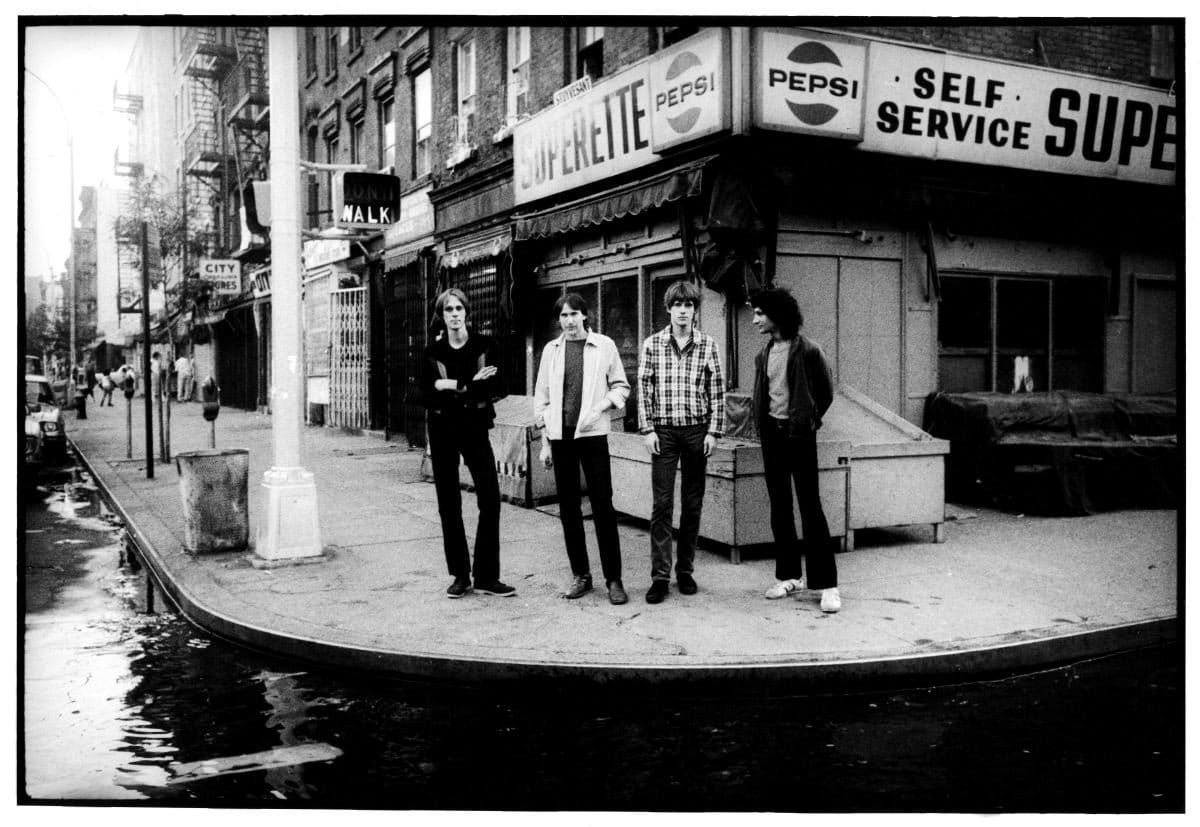
By the end of 1975, Television are in danger of being left behind. Horses bolts out of the stables in November and by December Patti Smith is being compared to Dylan, Keith Richards and Antonin Artaud in the pages of the New York Times magazine. Seymour Stein has signed the Ramones who are preparing their debut album for Sire. Talking Heads only showed up at CBGBs in June and they’re already recording demos for CBS. Meanwhile, Charles Shaar Murray, dispatched to New York by the NME to divine the sound of 75, dismisses Television as flakey, washed-up failures and not a patch on Tuff Darts…
But Tom Verlaine is biding his time, patiently charting a course from the corner of Bleecker and Bowery to the Eternal.
How does he get there? Practically speaking, one way is via the long schlep up Broadway to the A&R studio on West 78th St, where Television show up, having finally got a deal via Danny Fields with Elektra in November 1976. At this point the room is shabby and down at heel, a faded glory since Phil Ramone moved operations round the corner to the old Columbia studio on 7th Ave. But it’s here that he first recorded John Coltrane, Ray Charles and Stan Getz, who first blew the 10-year-old Tom Miller’s tiny mind. All these years later, Verlaine senses there’s still an atmosphere, a lingering portal, a way out of the mundane midday of midtown Manhattan.
Alternatively ask any New Yorker how you get anywhere in this city and you get an old answer: PRACTICE.
By the time Television finally rock up to the studio, they’ve played, by my estimate, approaching 150 gigs in two years, sometimes two or three sets in an evening. Of course, they still beat Suicide, working on their own geological deeptime, to a debut album, but for a supposed punk band they have definitively paid their dues.
Once Richard Hell left, taking his rudimentary Danelectro bass, leaving a vacancy for Fred Smith to make the move from Blondie, Television have been built on a solid foundation, the new pulse grounding even Billy Ficca’s wilder flurries. And ever since he unilaterally made the quixotic choice of “Little Johnny Jewel” to be the band’s calling card in the autumn of 1975 - prompting Richard Lloyd to storm out, before returning, chastened a couple of weeks later - Verlaine has steadily asserted his control over the group, even if he ultimately fails to negotiate the Elektra deal as solo artist plus backing band.
Billy Shankly once described a football team as eight blokes who carry the piano and three who can actually play the damn thing. It seems that Verlaine takes a similar view of the band, ruthlessly weeding out any challenge to his authority. Honed to a razor-sharp precision following weeks of rehearsal before they even enter the studio, Television are by now quite possibly the tightest rock band on the planet. The young Vic Godard, blown away after buying “Little Johnny Jewel” at Sex, describes them as “a modern jazz quartet”, but in truth they’re closer to a string quartet or a Bach fugue. The sketches and improvisation were worked out in the laboratory of CBGB and the eight tracks that will become Marquee Moon are now scored, notated, choreographed and orchestrated, an infernal, well-tuned machine in the brain of Tom Verlaine.
The last thing he needs is a producer getting in the way, so the recruitment of Andy Johns proves a masterstroke. The same age as Verlaine, Johns is already a classic rock veteran, working with the Stones through their early 70s imperial phase, and minting John Bonham’s drum sound on “When the Levee Breaks”. He’s lived through the Stones at Nellcôte and Led Zep at Headley Grange but even he isn’t prepared for New York in 1976. When his early attempts to mic up Billy Ficca’s kit to Bonzo dimensions are nixed by a horrified Verlaine he sensibly retires to the engineer’s chair with a case of wine and lets him get on with things.
But crucially, Johns’ mere presence alone grounds Television in the classic rock tradition, provides a link to the founding mid-60s miracle of Clapton, Page and Beck. The very title of the album is a compact manifesto: if the Marquee was the swinging London crucible where the the earth elements of the Blues - the blood, sweat and damnation of slavery, the sex and violence in which the early bluesmen found fleeting deliverance - were transformed into Rock, and the high sixties howl of liberation, then Television are a photographic negative or nocturnal version - chilly, lunar, all those raw earth metals sublimated into cool mercury.
In 1975 when the band were still vainly hawking around their demos, they were invited to audition for Atlantic Records. After hearing a couple of songs, a shaken Ahmet Ertegun turned to Jerry Wexler and said “Jerry, I can’t sign this band. This is not earth music.” For all his interstellar adventures, Jimi Hendrix was inextricably plugged into that earth music, the Doors were a very chthonic pagan rite, and even the Velvet Underground were rooted in the trash and squalid street hassles of the city. Television were the first rock band that cut the binds of gravity, sailed off towards the moon…
You can still hear remnants of the beat group - you can imagine the tightly-wound garage band that opens the album with “See No Evil” supporting the Yardbirds in the anomic London of Antonioni’s Blow-Up - though by the time they get to the cascading, scintillant “Venus”, they might be a better fit playing in some modernist Roman dreamscape in L’Eclisse.
The title track is an encapsulation of the journey. With its lightning, railroad tracks, and graveyard cadillacs it could be an imagistic scene from some godforsaken Robert Johnson blues, the deliberate bass and flickering, stuttering riffs like a jilted lover trying to get his motor started.
But the ascension, as Verlaine’s and Lloyd’s guitar lines entwine and ignite around the 7 minute mark, is like speeding up the Empire State Building in a glass elevator, the city lights suddenly sliding like the Millennium Falcon going into hyperspace, and, by 8:42 or so, shooting through the 102nd floor observation deck in a hail of glass, speeding out into the starry Manhattan night.
It’s tempting to see Marquee Moon as Verlaine’s Citizen Kane - a magnificent debut so immaculately conceived it became impossible to follow. If so, it’s crucial to acknowledge that just as Welles wasn’t the sole auteur of Kane - it was born out of the strange, sublime conjunction of Herman J. Mankiewicz’s script, Greg Toland’s lighting and lens, Bernard Herrmann’s score, not to mention the whole Mercury cast - then this is the record of a sublime band, not just players hitting marks and following directions.
Richard Lloyd was understandably a stickler from the start, wringing a co-writing credit out of Verlaine for “Guiding Light” and insisting his solos on “Elevation” and “Marquee Moon” were duly noted, but Fred Smith’s bass countermelodies (a different route though each chorus of “Venus”) and Billy Ficca’s drums, finally let off the leash for final swansong of “Torn Curtain”, are just as much crucial, foundational elements of the record as the unsung Jan Neeskens and Wim Jansen were to Cruyff and Michels’ Dutch immortals of 1974.
Released in time for Valentine’s Day 1977 in a Mapplethorpe sleeve, doctored by Lloyd on a primitive colour photocopier, Marquee Moon is brought down from the mountain by Nick Kent in the NME and showered with hosannas. But it fails to even dent the Billboard charts ruled by Rumors and Hotel California, and scrapes to 28 in the UK, alongside the Wurzels and Manhattan Transfer.
Almost immediately it feels like a record out of time. Punk is speeding ahead and splintering, and as Television tour the UK they seem to be fading out with each gig, as their support act, Blondie grow ever brighter. Having briefly caught the wave, they are already drifting out of fashion, slipping down some backstreet in history, on their way to the moment when Marquee Moon eventually find its own eternal orbit, out there in the stars with the Goldberg Variations and A Love Supreme…