Peat dust of the goldrush
Stephen Malkmus's meandering road to Pavement

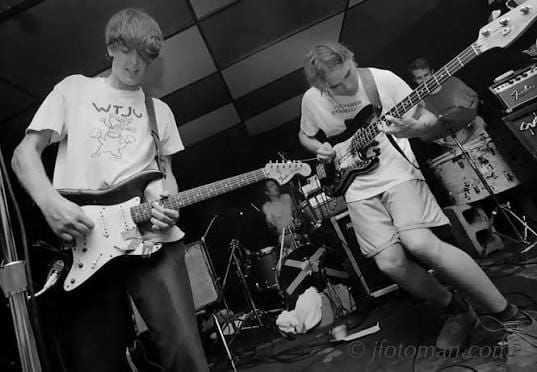
“Beneath the pavement, the beach!” declared the old Paris 1968 graffito, but what lay beneath the artfully scumbled surfaces of Pavement, the esoteric recording project that Stephen Malkmus and Scott Kannberg have contrived over a couple of years through the fag end of the 1980s with local burnout savant Gary Young? There’s certainly not much beach to be found around the dusty suburbs of Stockton, where Malkmus and Kannberg grew up precocious skate punks, covers of Devo albums taped to their boards, and where they’ve reconvened as post-grad slackers, conspirators and aspiring indie rock legends.
These past couple of years the boys have been slyly, patiently, goofily crafting their own nuggets of obscurantist small town mythology, the kind of oblique artefacts that might astound and confound future rock archaeologists, in the same way they themselves had been bemused and seduced by the worlds of Swell Maps, Chrome, The Fall, REM, Daniel Johnston, Flying Nun…
The EPs they issued through 1989 and 1990 were cryptic, elliptical communiques from a phantom garage underground - part slacker-prank, part avant-garde manifesto, part ransom note, part treasure map, part desert island bottle message. They succeeded beyond their wildest dreams, flying out into the world and garnering respect from zine snarklords and record store snobs, to the extent that, slouching through Mitteleuropa on his post-graduation wanderjahr, Malkmus heard his own record playing to the earnest appreciation of Viennese hipsters in some Neubau plattenladen. Meanwhile the Wedding Present picked up Slay Tracks on a New York stopover, covered Box Elder as a b-side, and passed on the record to John Peel, the arch druid, patron saint and enduring sponsor of exactly this sort of inscrutable primitivist arcana.
Mission accomplished? In the UK generations of groups were doomed never to outgrow this fond patronage, outrace their ultimate destiny as a Peel Band. But something in Pavement seemed to be uncharacteristically spurred by the growing acclaim. Over the Christmas of 1990, Stephen Malkmus returned to Stockton with a stockpile of new songs and the ambition to record an honest-to-goodness classic rock album, something that could be filed alongside Murmur, Zen Arcade and Daydream Nation without embarrassment. If the EPs had been clues, footnotes, marginalia, apocrypha, then the album had to be the motherlode, the treasure everything to this point had only hinted at.
How’d they manage it, this unprepossessing, oddball, low-watt power trio? Back in New York, in his day job as hungover art guard at the Whitney Museum, Malkmus and his buddy David Berman would idly plot how they might one day conduct a heist of some invaluable Jeff Koons bauble or Rauschenberg doodle, but invariably concluded they were too darned slack to pull it off. Now somehow, with the help of an old school pal and an acid fried producer cum drummer, Malkmus has got it sufficiently together to pull off his own masterstroke.
Perhaps the return to North California was crucial? Malkmus took the title “Slanted + Enchanted” from the caption of a Berman cartoon of a bug-eyed stickman, but maybe he needed to put 3,000 miles between him and the overbearing influence of his work and roommate. In New York, Malkmus and Bob Nastanovich were pulled along by the dark, daft gravitational force of Berman’s personality (hear them on youtube bootlegs follow Berman’s lead, playing up to their own idea of East Village wise-asses, heckling Nirvana when they pulled through Manhattan in April 1990). A Pavement born in NYC might have been all in-jokes, sub-Sonic Youth avant goofballs.
But back on his childhood streets, breathing in the peat-dust of the old gold-rush town, rifling through the classic rock of his parents’ record collection, Malkmus was free to loosen up, reconnect with his provincial punk past and his teenage yearning. Scott Kannberg, who came up with the name Pavement in the first place, couldn’t be less New York, his time at Arizona State only confirming his heartfelt commitment to the earnest cottage industry of college rock.
And just being in the same room as Gary Young is like getting a contact high. Young supposedly dedicated the year 1969 to assiduously taking acid every single day, but may have been even more profoundly reprogrammed by the experience of hearing Zappa, Yes and the Mahavishnu Orchestra. As a young hippy turned old punk - a west-coast cousin of John Peel - Young assembled his home studio as his desire to have the biggest possible stereo started to get out of hand, and after recording and playing drums on the EPs, has slowly come round to the idea that this Malkmus idiot is “a complete songwriting genius”.
For the first time in January 1991 they rehearse as well as record the songs, and it’s this sly surfacing songwriterly craft that is the real discovery of the new Malkmusian material. “Summer Babe” has the careering pop hooks of Dinosaur Jr covering the Cure, and is the kind of venerable Californian hot girl summer anthem Bill and Ted might have composed if they’d grown up on the Replacements instead of Aerosmith.
But it’s “Trigger Cut” that feels like the breakthrough. “Lies and betrayals / And fruit-covered nails / Eeee-leck-tricity / and lust,” Malkmus drawls, like he’s itemising the ingredients of his own surrealist cocktail, his witchy lyrical recipe. The song itself conjures a phantasmic post-punk soft-pop, as though the Jim Croce of “Operator” had joined the Wire of “Outdoor Miner”. Lofi was always a misnomer for what Pavement were up - Gary would be insulted by the suggestion that his productions were anything less than the highest fidelity. This was more like a very deliberately skewed, scuffed but steely Californian sophistipop - if not yacht rock, then indie for the abandoned houseboat.
And boldest of all, amid the punk-pastiches and cryptic allusions, Malkmus has somehow found it within himself to record a bona fide classic broken hearted ballad. If “Pale Blue Eyes” is the mountain spring, the very source of the indie rock delta, then “Here” is that same current, filtered down through a couple of decades, through REM and the Paisley Underground b-sides, an underground river, slowly resurfacing through the paving stones of North California at the dawn of the 90s. The river was to break its banks a few months later with the unstoppable tidal bore of Nevermind, but for a moment, as Slanted and Enchanted circulates across the indie networks on samizdat cassette looking for release through 1991, Pavement have divined their own meandering tributary. They could sail through the decade on it.