Really blasting
A radiant new perspective on Rubber Soul

“Anything that ever happens anywhere in the universe is recorded in light neutrons,” explains the Doctor’s assistant, Vicki, in the episode of Dr Who broadcast on BBC1 on Saturday evening, 22 May 1965. She’s introducing the Doctor’s Time and Space Visualiser, a Heath-Robinson time television which enables the viewer to tune in to any event in history. After checking in on Abraham Lincoln delivering the Gettysburg Address, and a Shakespeare audience with Elizabeth I, the crew of the Tardis dial in to the year 1965 where the Beatles are dimly visible on Top of the Pops performing “Ticket To Ride”. “Well, they're marvellous,” exclaims Vicki, an excitable teenage orphan from the 25th century. “But I didn't know they played classical music!”.
Nothing is ever really lost - everything is recorded forever on some cosmic frequencies. That certainly seems to be the promise of Giles Martin’s sonic odyssey back through Beatles space-time, which now also tunes into the year 1965 with the Super Deluxe Special Edition of Rubber Soul, made possible by technology undreamt of even by Timelords. The spectral demixing algorithms of Emile de la Rey and the boffins at WingNut Films have translated the old light neutrons, made possible sensational new stereo and mono mixes, while the archival trawl has uncovered an array of demos, early takes, and somehow, this late in the day, an entirely new “song outline” never previously even rumoured. Even if much of the new scintillating stereo Rubber Soul is familiar from the tracks that appeared on the remastered and expanded 2023 Red Album, here is a radiant new perspective on the Beatles’ pivotal album.
By the autumn of 1965 the Beatles had played Shea Stadium, partied with Elvis and comprehensively conquered the US - but they still hadn’t quite taken control of the recording studio. They were after the total sonic freedom, the needle-jump bass bump, groove and swagger they had heard in American records, from Spector to Motown, and which the Stones seemed to have casually acquired by recording “Satisfaction” at RCA Studios in Los Angeles.
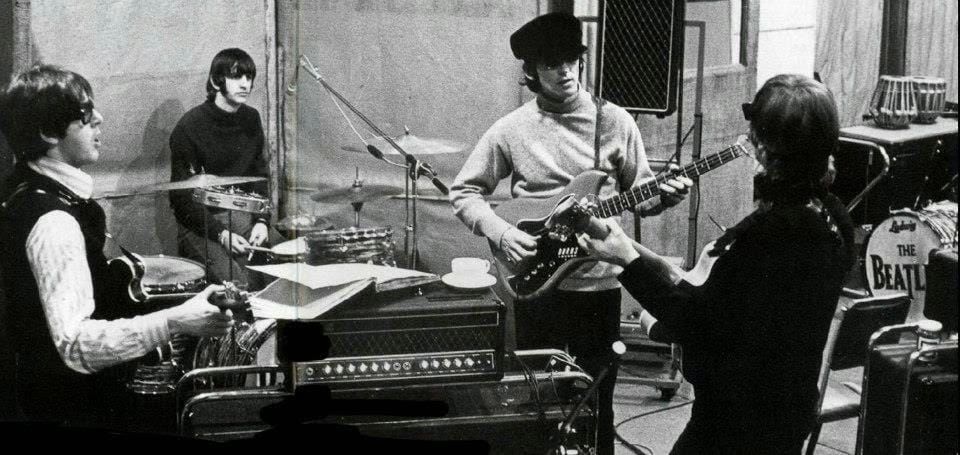
When they reconvened in EMI studio 2 on Tuesday 12 October they brought back the fruits of their imperial plunder, all the necessary ingredients to make their first masterpiece: the jukebox full of Stax, Motown, Dylan, Byrds and Beach Boys 45s, the Sonic Blue Stratocasters, the Fireglo Rickenbacker bass, the crummy Indiacraft sitar. They smuggled in jazz woodbines past oblivious EMI studiohands. They opened up the Hammond and harmonium, and unlocked the cupboard under the control room stairs, the one full of wind machines, Moroccan drums and strange tambourines. (“You could walk in with an elephant if it could hold a note,” said George.) Most of all they opened up themselves, divined liberating paths out of their old routines and formulas…
But for the moment they were still rolling along on the same showbiz treadmill, tasked with delivering their second contracted album of the year in time for Christmas. They entered the studio up against a hard deadline, and it showed. The first song they recorded, “Run For Your Life”, was John at his laziest, most cynical - a line from Elvis’ “Let’s Play House” whipped up into a scuffling, skiffly, faintly Stonesy number, which, as the additional disc of early demos and early takes makes plain, still took five painful takes to nail down.
Were they just getting warmed up, clearing their throats before the real work began? The breakthroughs were almost immediate. After calling time on “Run For Your Life”, the band worked straight through dinner, laying down the first take of “This Bird Has Flown”, a mordant, droning and very grown-up waltz through late night infidelity and revenge. Was he responding to the verbal gauntlet laid down by Dylan or the closer to home teasing of journalists like Maureen Cleave or Kenneth Allsop? If anything the sound is even more striking. The first acoustic take is familiar from Anthology 2, but the second take, from the sessions on 21 October and revealed here for the first time, voyages enthusiastically into psychedelic realms on the magic carpet of George’s wobbly sitar. It’s a journey that they maybe weren’t quite equipped for - the reined-in sitar on the third take is technically better, but clearly they were already setting new co-ordinates for the beyond.
“Drive My Car” was arguably an even greater advance. It had started out as one more song about buying diamond rings, but in late 1965 that clearly wasn’t going to cut it anymore. Between them Paul and John worked up a more hip scenario: a young hustler, dreaming of Hollywood, recruiting her entourage before she’s got a sniff of success. Most of their songs to this point had been addressed to their audience, set in some courtly scouse suburbs of the heart; now they were cruising through Detroit or maybe even LA with one more sassy young woman only too ready to outwit them.
Musically they were now riding along on a deluxe chassis, one clearly inspired by the groove Booker T and the MGs had perfected on Otis Redding’s “Respect”. Maybe the single greatest revelation of this new Rubber Soul is that at the close of 1965, even as Jeff Beck joined the Yardbirds and the Stones went supernova, the Beatles were still the smartest, swingingest, RnB group in the UK. This is abundantly clear on the early instrumental takes through “Drive My Car” (crucially their first recording session to continue beyond midnight). But it’s most vivid on “Day Tripper”, the single written to order, which you can now follow as it grows from a Kenwood songwriting session (“wow, we were really blasting!” says a giggling, exhilarated John, clocking the levels of his home tape machine) into an elite RnB jam.
Even on “The Word” and “I’m Looking Through You” collected on the second disc and you can hear Paul growing into a generational bass player, George becoming the soul man he always dreamt of being, Ringo holding a groove as tight as Al Jackson and even contributing hammond organ freakout on a wild third take of “You Won’t See Me”.
Of course no new Beatles product is quite complete without a new song, and this might have felt particularly pressing when so much of this material, through the new Red album and the various Anthologies is already familiar to Beatles compleatists. But with “Little Girl”, recovered by Sean Lennon from his dad’s old tape archive, and hardly hinted at in the band’s compendious literature, you wonder if the bottom of the barrel has finally been reached. It’s an unexpectedly sweet acoustic sketch, as though John was already overcompensating for the misogyny of “Run For Your Life” - “Little girl, I’ve come to say that this has been a lovely day: I love you”. The sweetness is soured a little by the second verse - “If you’d come by yesterday then I’d have told you sweet FA”, and the chord sequence feels a little like an early run at the hynogogic haze of “I’m Only Sleeping”, but as the “song outline” hedging in the tracklisting indicates, this is a very minor addition to the canon.
It’s certainly overshadowed by more authentically revealing surprises, such as the early drafts of “In My Life”. Here, after all these years, you can suddenly hear the miracle of the Beatles anew. The first take makes plain the original immaculate concept for the song: a bittersweet Smokey Robinson cruise, along the lines of “Tracks Of My Tears” or “My Girl Has Gone”, through some murky, Merseyside memories as John Lennon turns 25. Then, Friday morning 22 October, waiting for the lads to arrive, George sits down at the Hammond organ and sketches out a pipe dream of a solo the tune has awakened in him, memories of his time at Guildhall after the war, studying Bach and the baroque as an earnest teen pianist.
The idea was good, but his technique was imperfect, so he went back and recorded it on piano at half speed, then sped it up to create a kind of tack harpsichord, and, ever the perfectionist, quietly buried his first draft before running it by the boys. But the fumbling first take lets you hear afresh what an incredible group this was, what a rich and strange conjuncture: 1960s Motown, 1950s Liverpool, 1940s London and 1730s Leipzig somehow combining into a rare moment of pure invention and delight. The Beatles: they’re marvellous, and they certainly made classical music.