Tokyo Story
Paul gets his wings clipped in Japan

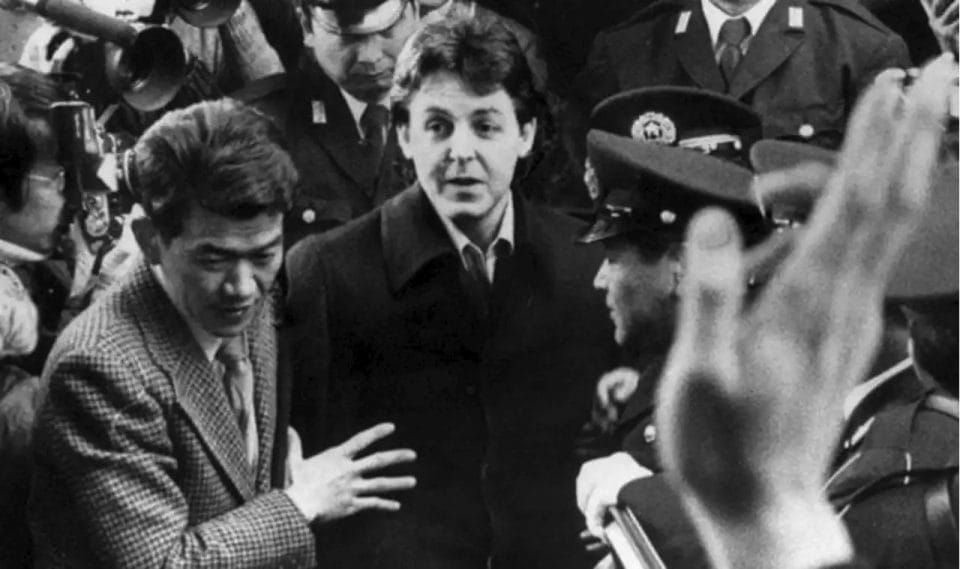
- SHŪJIN NIJŪNISAI? (Prisoner 22?)
- HAI! (Here!)
It turns out that Paul McCartney is a model prisoner. Sunrise at Kosuge Prison, January 1980, and he is already up, his threadbare tatami mat folded, tiny cell swept clean, sitting cross legged and awaiting his inspection.
He is aiming for some old fashioned grace under pressure. He’s thinking of - who was it now? - Alec Guinness? In Bridge On the River Kwai? The very proper colonel in the prisoner of war camp, who sees no reason why his boys shouldn’t build a bloody good bridge for the Japs. Jim McCartney never went to war - too old, a dicky left ear - so Paul finds his role models where he can.
Truth is, he’s barely slept. All night he lay with his back pressed against the cold cell wall, paralysed with fear. Is he going to be beaten? Or worse? He can hear John’s voice, mocking in his head: “Yer too pretty for jail, Paulie!”. There’s a guy a few cells down with a full back tattoo, a roaring dragon, all livid blue and green. Doesn’t that mean yakuza?
He has never felt so alone. Maybe 1956, after his mum died, and he moved into his own box bedroom at the front of the house on Forthlin Road, trying to find some comfort in the old tunes drifting up from the radio? More like November 1960 when he was picked up by the Polizei and thrown in a Hamburg cell after leaving a squalid parting gift for Bruno Koschmider at the Bambi Kino.
Some might say that Paul is the laureate of loneliness - all those old spinsters and priests, sweeping up after other people’s weddings. But in the last 20 years he’s barely known a moment by himself - the sixties a mad blur as the world rushed up against his limo windows, the seventies a domestic dream of kids, dogs, life on the farm.
He has let Linda down. He has let his children down. There was a certain scally honour to be thrown in the clink as a kid, like some sozzled seadog after a night on the razz. Now he’s pushing 40, with a family and a band to support. It’s not becoming a man of his position. Just a couple of months ago the Guinness Book of Records named him the most successful songwriter and recording artist of all time. Not only are they running out of superlatives, they are running out of precious metals. Deciding he has quite enough gold discs, Norris McWhirter presented him with a record made of solid Rhodium - one of the rarest metals on earth, and probably a useful hedge against inflation right now.
What on earth was he thinking? He is an old hand at crossing international borders, charming the officials with that Fab Macca twinkle. Back in the double-decker days of Wings, before they got anywhere near customs, he would lead the band and crew in a solemn ritual, casting their weed from the top of the bus, as though scattering the ashes of the dear departed. But flying into Tokyo he could barely be arsed hiding the baggie - even the poor old customs guy seemed a little embarrassed to find it there, like some kids pop-up book.
Sipping on his breakfast of seaweed soup, he has to wonder - did some part of him want to be caught? He’s never been much of a Catholic but he can’t shake a stubborn, lingering guilt. It’s all seemed too easy - waking up in the morning with a tune stuck in your head - something about scrambled eggs, a nursery rhyme, a bagpipe melody you feel sure is as old as the Argyll hills - and the next thing you know here’s your hundred acre estate, your Arizona ranch and you’re touring America by private jet. Is there no price for this charmed life?
The other three certainly seem to be paying. Ringo’s house in LA just burned down. After all those years in court, George seems sick of everything and everyone, intent on becoming the mad old hindu hermit of Friars Park. And where’s John? Can he really be happy up there in his own seventh floor cell, baking bread and watching the wheels of the world go round? Even his scorn feels full of self hate. “You’re all pizza and fairytales!” he snapped at him late one night on the phone.
What’s wrong with that? He may as well be on trial for murder if it meant a slice of margarita right now. He kept on showing up at the Dakota with an acoustic guitar, hoping for one more jam. In the end John turned him away - “you can’t just show up man, I’ve got a kid.” He remembers, deep in the slump of the Get Back sessions at Twickenham, trying to get a smile with an old Mississippi work song, Leadbelly by way of Lonnie Donegan.
Tell the captain I was headed for the river
The song was like a spell for reaching John even in the worst times. He tried it once again, in LA, in 1974, when he swung by the Record Plant, shocked to find him and Harry Nilsson like pigs swimming in their own swill. He sat in at the drumkit, picking up the rhythm, trying to pull them all through it.
If he asks you was I runnin' tell him I's flyin'
The Colonel Bogey March didn’t go down too well, so, ever the trooper, the indomitable Butlins redcoat, Paul gives it another go. Singing out into the prison yard he wails:
Tell him I'm gone gone gone, tell him I'm gone.
The old yakuza in the cell at the end of the hall claps along and cheers. Through the prison guard he makes it known that he has a request that Paul is in no position to refuse. He has just one word of English, but even through the accent, it is very clear. He smiles and nods as he asks:
“Yesterday?”