Taking stock
In midlife Nick Cave has become a man prone to reckoning

Nick Cave's days are numbered. He knows because he has counted them.
In midlife he has become a man prone to reckoning. In his sea front office, around the teak galleon of his desk, there are maps and charts, notebooks and diaries, plotting every step of his progress from Warracknabeal, 1957. If the days of his allotted years are threescore and ten, then he calculates he has 25,550 days in total.
At 5,000 he was moving to Melbourne and enrolling at the hated Caulfield Grammar, 1971.
10,000, he was in West Berlin, 1985, summoning the Bad Seeds to tour The Firstborn is Dead, slouching in a Kreuzberg priesthole to compose And the Ass Saw the Angel.
Now, in the summer of 2012, pushing 55, he has just clocked 20,000 days. The home stretch approaches. He needs to take stock.
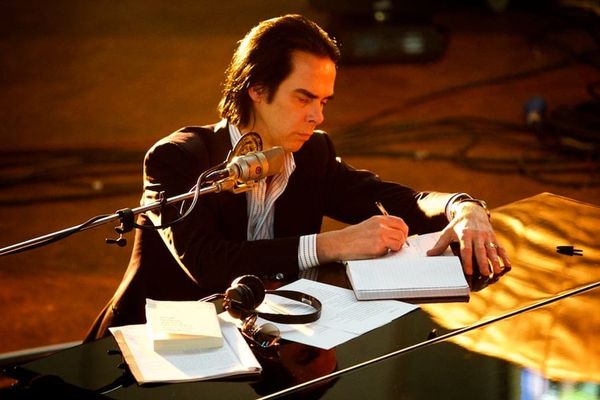
Back in the twentieth century, drugs imposed their own diurnal discipline, but over the past ten years he has acquired more bureaucratic habits. Most every morning, when he isn’t touring or recording, he pulls on the same Bella Freud suit and tie, makes the same walk from Kempstown dream home to Hove office, sits at the same Olivetti typewriter and paws at the same Rogers Eungblut upright piano. He has become a crafty compartmentalist, a maverick demon of industry, following Flaubert’s edict: live like a bourgeois so you may think like a demigod.
Here, carefully labelled and shelved, are the leatherbound logs of the good ship Bad Seeds, charting the stately if errant odyssey, as they lost Blixa, Mick Harvey and James Johnston overboard, from Hansa to La Fabrique.
Here, tagged and zipped, are the atlases and gazetteers for the strange, apocalyptic soundworlds he has mapped with Warren Ellis for The Proposition, The Assassination of Jesse James by the Coward Robert Ford, The Road and Lawless. Here, neatly typed and bound, are screenplays for a couple of these films, plus the infernal manuscript for Christ-Killer, the Gladiator sequel that was never to be.
Here, smelling of brandy and Lambert and Butlers, is the manuscript of The Death of Bunny Munroe. Here are the archives of all the collaborations, from Johnny Cash to Debbie Harry and Marianne Faithfull. Here are the scholarly lectures on love songs and gospels.
And here, fizzing in a secured, refrigerated Erlenmeyer flask, is the limegreen monkeygland elixir that transforms him into the priapic, moustachioed old goat, Grinderman.
What, in the end, does it all add up to? He remembers his father taking him aside one day after school in the late 1960s and asking, in his grandiose pedagogical manner, “What have you done to assist humanity?”. Dumbfounded, he’d flipped the question round, and was shown two primly preserved 1950s journals, featuring short stories by Colin Cave - “tiny seeds planted in a garden that did not flourish”.
Back then he had vowed that it didn’t matter what he did with his life as long as he didn’t end up like his dad. He’s older now than Colin ever got to be, and he long ago realised there is no action he can take that does not draw them closer. From the keys of the clapped out Olivetti, the good son has cultivated and tended not just a garden but an entire fucking rain forest.
He needs to come up for air. He likes to curate the image of the reclusive, vampiric genius, working in darkness, fuelled by lust, despair and an inexhaustible hunger for grandeur. Some might suggest that this persona is in fact his greatest achievement. But the real work is done in the light and air of conversation and collaboration.
Over the past decade Warren Ellis, this feral ex-junkie with the Rasputin beard and Paganini brow has slowly, slyly become his ultimate collaborator. In his own larrikin way he combines elements of Rowland Howard’s ruined, lunar beauty, Mick Harvey’s gnarled intensity, Blixa’s serrated wit and maybe a distant hint of Anita Lane’s wry, darkling glamour. It is Ellis above all, this weathered, infuriating, psychedelic old starsailor, who has powered and enabled the astonishing 21st century outpouring.
They have just spent a month together in the south of France - an unimaginable time for the hitherto combustible Bad Seeds - sipping wine, swimming lengths of the pool and fine-tuning their fifteenth album, Push The Sky Away, ensuring that every loop, squeak, shudder and whine of violin, viola, flute and Korg is attuned to the astral frequencies that Ellis can feel, humming away in the Provencal night.
Somehow, this late in the day, it feels like a fresh start, a new chapter, maybe an entirely new wing of the archive? He’s particularly pleased with the penultimate song, a moody, rambling, insomniac blues on the road to the Large Hadron Collider near Geneva, in search of some elusive God Particle, accompanied by Robert Johnson, Lucifer, Hannah Montana and Miley Cyrus. “Can’t remember anything at all!” he howls - and truly, these days, this is the thing that terrifies him, more than damnation or oblivion or any old Bluesman’s hellhound - the loss of memory, his real medium and artform.
He has six weeks now back home, barely 40 days, to gather his thoughts, wrestle with his unfeasibly large teenage sons, now teetering on the impossible brink of teenagerdom, get reacquainted with his wife, listen to the recordings ahead of flying out to LA to mix the whole thing with the indefatigable Nick Launay.
On the journal before him on the battered, ink stained desk, he has it all meticulously scheduled and diarised. His days are numbered. Oh yes: this is the life. Who cares what the future brings?