Slug slime
The Birthday Party leave London for Berlin

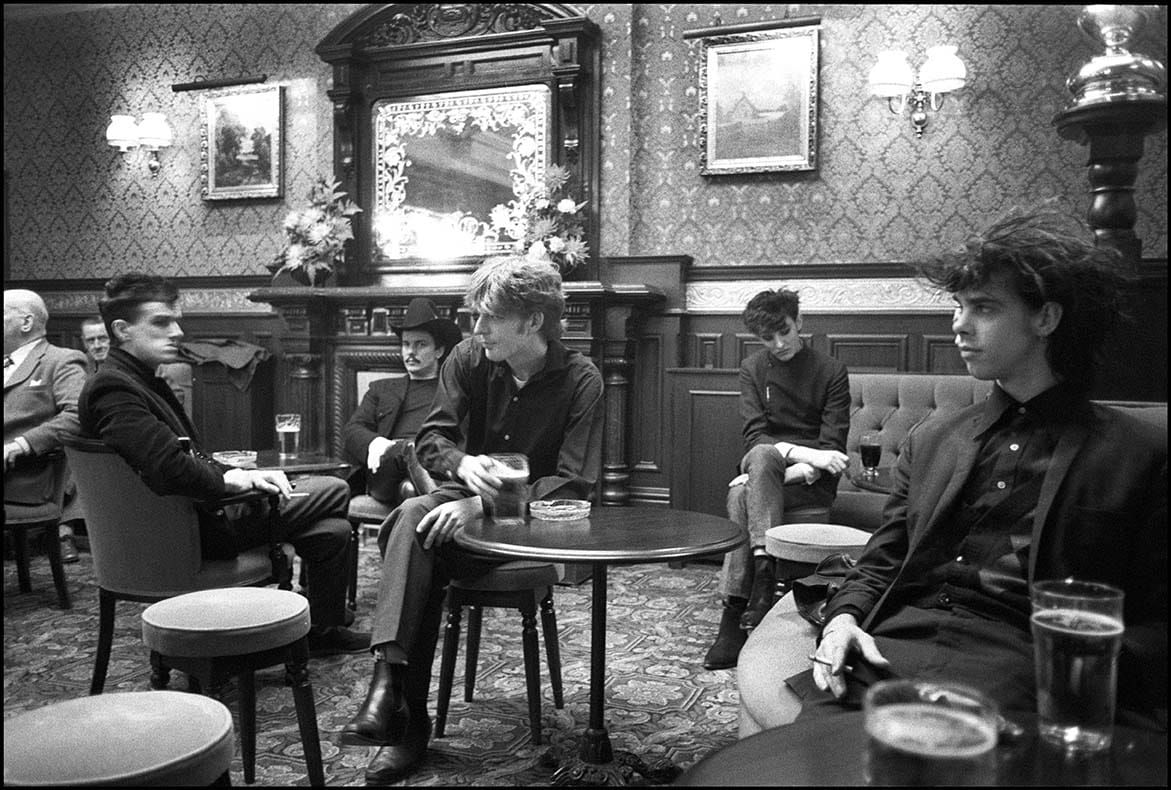
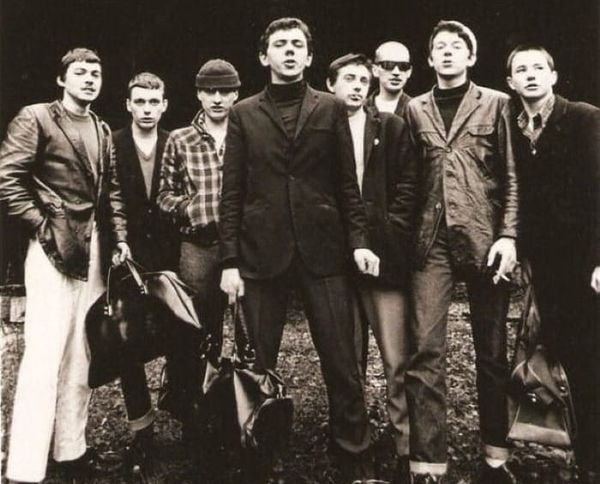
“The Birthday Party,” Nick Cave patiently dictates down the phone to the NME in December 1982, “are in essence a slug, nomadic, and their journey is slow and painful and always forward.” He’s enunciating like his schoolteacher father, making sure they get every word here, these journalist perverters of language. “Their trail of slime is their art, and so on, and they are barely conscious of its issue, which bears little resemblance to anything but ourselves and we make no excuses for that.”
The slug started small, but over the past two years has grown into a monstrous, snarling mollusc that has slithered its way around London, consuming and excreting all the city’s junk and bile and disease, as though very slowly circling a drain. It has been disgusted and dismayed by the sorry shambles of the city’s music scene, even as its notoriety and audience have grown. The concerts have grown into rites and riots of chaos and black magic that fitfully get translated into records that capture stray shards of their derangement.
The ectoplasmic howl of “The Friend Catcher,” released by Ivo Watts-Russell on his fledgling 4AD label in October 1980, pricks up the ears of John Peel and a nation still mourning Joy Division. Prayers on Fire, recorded on a flying visit back to Melbourne over Christmas 1980, comes most vividly alive in the lurid video for “Nick the Stripper,” a Boschian bacchanal shot on a toxic garbage pit in Camberwell. “Release the Bats,” tossed off in the summer of 1981 as part of their mirthless disdain for the emerging Batcave fiasco, risks inadvertently defining them as gothic pantomime.
It’s only with Junkyard, recorded in Melbourne through the depraved winter of 1981, that they come close to capturing much of their chaotic majesty. When it’s finally released with its magnificently misguided Ratfink sleeve in the summer of 1982 and goes to number one on the UK Independent Charts, they decide enough is enough and slide all the way to West Berlin.
Since they first touched down in the northern hemisphere, it has seemed damned inevitable that sooner or later The Birthday Party would end up on the eastern front of the western world. What took them so long?
Maybe it’s the boundless hospitality of Christoph Dreyer, urbane guitarist with angular instrumentalists Die Haut, who seems to have housed half of Melbourne in his Dresdner Straße loft. Maybe it’s the opiates and amphetamines haemorrhaging into West Berlin via the incompetence, corruption and/or strategy of GDR customs at Schönefeld Airport. Maybe it’s the nightclubs operated by Turkish gangsters, keen to offer free drinks to bohemian celebrities.
Or maybe it’s just the ghastly glamour of Blixa Bargeld. If Peter Lorre and Sally Bowles were the city’s exemplary phantoms in 1931, and Romy Haag took over the role sometime in 1974, then Blixa is the undisputed face of West Berlin, 1982. Nick catches sight of him on a Dutch TV screen one night in June and is bewitched by this hellboy with cheekbones sharper even than Rowland Howard’s, bashing at corrugated iron with inscrutable fury, like the little kid from The Tin Drum all grown up into a shock-haired, leather-clad Struwwelpeter.
The city lives up to its poster boy, and a bullet-scarred loft in Kreuzberg is a more obviously fitting, more mythic base than a dank basement squat in Kilburn. Nick immediately feels at home, art-directing his splendidly squalid office with typewriter and revolver, German gothic art and locks of women’s hair, and carefully hangs his painting of a naked, sprawling green lady.
When it’s finally time to record, of course they stagger across Kreuzberg to Hansa, by the Wall. The Birthday Party are in the business of raising demons, summoning spooks, and the vast resonant halls of Hansa are lousy with them – from George Grosz and John Heartfield, who exhibited here in the ’20s, to the Reich Chamber of Music, who hosted balls for the SS in the ’30s, right through to the familiar spirits of David Bowie and Iggy Pop from just five years ago.
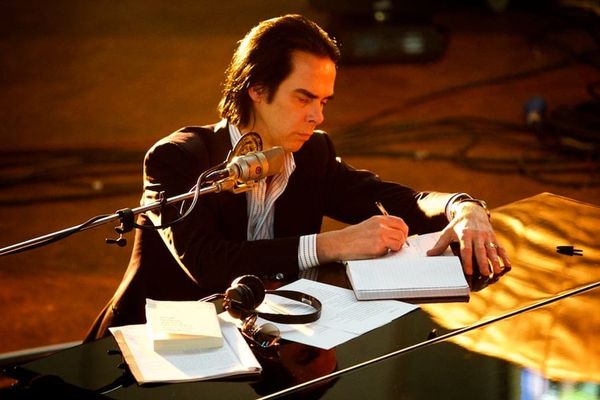
But the band are already giving up the ghost. Drummer Phill Calvert is long gone, having been tossed overboard somewhere over the English Channel. Tracy Pew is back after his conviction for approaching his own kind of perfection, but seems to have left an important part of his brain somewhere in a jail near Yarram. Nick seems to have lost interest in any music that isn’t the Walker Brothers or Hank Williams. He’s increasingly tied to his typewriter and his notebook, cooking up scripts and spells with Lydia Lunch, as though written words are the one thing he can maintain sole control over. And as the lunar presence of Blixa in the studio waxes ever more brilliantly, Rowland seems to be visibly waning every time you look at him, until he’s a pale, spectral emanation behind his white Fender Jag.
Watch Heiner Muhlenbrock’s film of the final Hansa sessions for Mutiny, recorded in April 1983 - like black-and-white surveillance footage of an exceptionally well-equipped but stultifying asylum - and it becomes clear that by now the vast leviathan slug of The Birthday Party is a kind of zombie organism, like one of those insects that gets infested with parasitic worms, wasp larvae or pathogenic fungi, and continues to move even as its vital organs are hollowed out. When prodded or poked or jolted with electricity it still spasms and sprawls, shudders along, plays concerts and even releases EPs. But that silvery mucous juice is no longer flowing, the trail of disgrace is drying up.
What will emerge as the carcass finally rots and splits open? What dark seeds have been sown in the monster’s guts? Nick Cave combs back his hair, pulls on a tie and gets ready to emerge for his next act.