Scary monsters
Dry Cleaning explain how art and humour are our best defence from techbro supercreeps

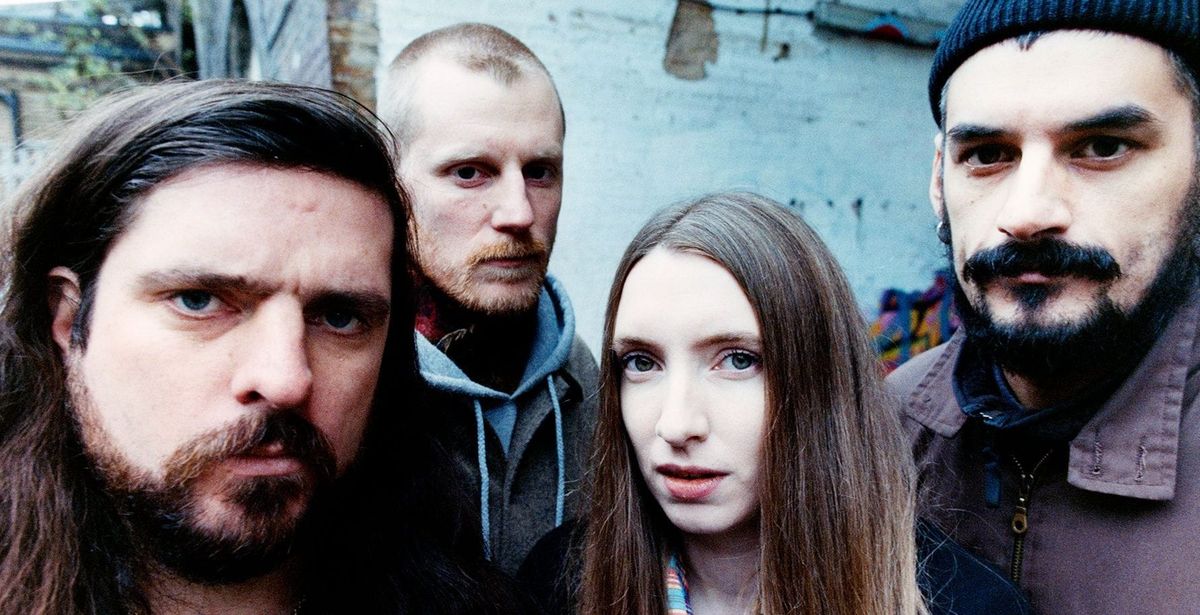
It is a crisp early autumn evening and Dry Cleaning are back in their native environment - holding court in the back of a dark old man’s pub, deep in the heart of Peckham, south-east London. It’s been a long time. After a slow start, when Covid scuppered their plans to tour their debut album, since lockdown eased they’ve made up for lost time, racking up thousands of air miles, and performing almost 300 shows, from Japan to Chile (no less an expert than Simon Le Bon firmly advised them they should take a break).
On the face of it they seem a very unlikely international export, their surreal and sardonic tales of lost pets, royal weddings and adult education classes, and their defiantly lo-fi post-punk instrumentation, as much a peculiarly English taste as scampi fries, battered sausage or Half-Man Half Biscuit.
And yet they have proved a spectacular international hit. In 2022 Grace Jones selected them to play at her Meltdown week in London. In 2024, Wilco invited them to perform at their Solid Sound festival and to record at their Chicago studio. And they were selected by Nick Cave to join him at his triumphant Wild God tour of Europe.
Now, having returned from a journey from Chicago via Dublin to the Loire Valley in search of a producer and a studio, they’ve back in their old manor, to tell the story of their phenomenal new album, Secret Love, and try to explain how they have managed to translate years of friendship, enthusiasm and obsessions into daft, devastating, uncannily moving popular music.
“I really think it definitely comes back to the art school thing,” says Nick, the philosophical drummer, talking of the band’s shared histories in London’s surviving experimental arts institutions. “I think it has influenced how we describe things and how we communicate musically. We have been working so closely for so long, it has been a musical education…”
“I could not even spell guitar before I joined this band,” deadpans guitarist Tom. Spend any time with the band and you’re struck by the telepathic way they finish each other’s sentences, support each other’s doubts, and, invariably, gently deflate any dawning grandiosity.
Nick is warming to his theme. “When Tom says something like ‘I want the guitar to be more sci-fi’, or when Cate, our producer, tells us that a section of a song needs to ‘go to Belgium’, I know exactly what they mean,” he says. “The things that we read and the films we watch, even the different ways we draw, all these things feed into how we understand each other. And then that leads on to a whole other network of ideas and feelings and hopefully musical creativity…”
Is Dry Cleaning, among other things, a private joke that has inadvertently gone very public?
“It kind of is, to be honest,” smiles Florence, peering over her specs. “But the annoying thing about in-jokes is that they are not always funny to anyone else. So I feel like the hardest part of the task is just making sure that it does not exclude people. And hopefully we succeed at that, sometimes. I feel like the only way to make something of value is to put yourself into it.”
“I think we have always been quite good at communicating,” adds Lewis, the bass player with the hair and tattoos of a death metal roadie and the calming manner of a wise librarian. “I think the intent is quite pure. It is not a secret. We are trying to entertain each other and as a result we are projecting it to everyone else.”
“I think the key thing about Dry Cleaning is that we are four very strong, distinct personalities,” concludes Tom. “There is no mistaking that Lewis sounds like his bass lines. People say I sound like my guitar and obviously Flo sounds like herself…”
++++
Talking Heads wryly titled their second album More Songs About Buildings and Food, and it is not hard to imagine a Dry Cleaning album along similar lines, More Songs About Meal Deals and Soft Landscaping perhaps, or More Songs About Sausage Rolls and Footwear. Uniquely, among British bands of the last decade, they have conjured a distinctive world all of their own. Since coming together almost by accident in 2017, already in their thirties with grown-up careers and relationships, over the course of three albums and three EPs they have refined a mordant, surreal, south-east London of the soul, animated by the everyday comedy, dread, dislocation and detritus of the 2020s, as though the spirits of comedian Sean Lock, novelist Nicola Barker and post-punkers Gang of Four were enjoying a chance encounter on the top deck of a night bus somewhere near Peckham Rye.
Secret Love, their third album, is their most extreme and accomplished work yet, turning up the contrast on both their ferociously intense post-punk clangour and their dreamy ASMR intimacy. At a time when so much culture is designed to offer therapeutic, feelgood bubbles of escapism, nostalgia or relatable confessional, it is an album that has the vivid, lurid, sometimes distressing texture of life in the 2020s.
Forty years ago, formulating their own semi-detached take on English rap, Pet Shop Boys caught something of the intoxicating vertigo of a London on the rise, the early days of the neoliberal Big Bang, taking off from seediness into would-be sophistication. Dry Cleaning are laureates of the comedown, the long crash, where the morning domestic doomscroll brings cute animals, gossip and ghosted hookups, incessantly interspersed with ads, slop and live updates on the latest genocides, floods and hurricanes. Their vision of escape is a long undistracted afternoon on the sofa watching telly (“No one coming along with a video call or a survey or a dick pic or a loud bang,” sighs Florence on the dreamy “Let Me Grow”.)
Teased into existence with the help of producer Cate Le Bon over sessions in rural Brittany in the summer of 2025, it is an album of beauty and brutality, violence and intimacy. The cover, by Canadian Scottish artist Erica Eyres, captures the vibe uncannily. It is an uncomfortably close-up painting of Florence’s eye being held open. The gesture evokes nightmare images, from Luis Buñuel’s Un Chien Andalou to Stanley Kubrick’s A Clockwork Orange. But there is no violence here. The unseen nurse holds the eyelids gently and seems instead to be cleansing the eye, washing away all the city’s grit and grime, maybe, somehow, washing away some of the accumulated twenty-first century horror we have all been endlessly, helplessly witnessing.
The band, though, are characteristically reluctant to take credit for any conscious evolution in their art. “I do not feel like we have a master plan for our records, do we?” says Florence, a little flustered, this early in the new promo cycle, at charting the group’s progress across three albums. “Mainly, just play together and improvise and figure it out doing that. There is never any road map or a plan of what we want it to sound like. We definitely said something along the lines of pushing into the corners of what we sound like, but of course that is what anyone would want to do.”
“I think it becomes easier to plan the further you get into your career, because maybe you feel more confident, and you have ticked off a few things that you have done in the past,” offers Nick. “You have got more space or flexibility to push into slightly different areas.”
“There was definitely a conscious choice on my part to do more sweet, gentle things on the guitar, things like ‘Let Me Grow’. And it seems obvious that I would do some noisier stuff as well. Can you even call it planning though?” wonders Tom, the most restless, exuberant member of the band. “There is no leader in Dry Cleaning. It is just four people doing their own thing. You can only really control your quarter of the band. And then you see if the others will either be influenced by what you bring and go with it, or they will push against it and make something else with it. Or maybe they will ignore it and do what they always do. I think all those options are quite interesting. But there is never a plan. No one is in charge.”
+++
The group took this anarchy to its logical conclusion when they started to work out ideas in preparation for Secret Love. After recording their first two albums at Rockfield Studios in deepest Wales with John Parrish, they were keen to push the boat out further and experiment for a while. “We loved working with John,” says Tom. “He is incredible, a really class act. He was the only producer we had ever worked with. But producers really steer the ship, and we wanted to see where we could get to without that steer.”
It proved to be a wayward voyage taking in the Dublin studio of Gilla Band and the Fish Factory in north London. But it began in Chicago, when they were personally invited to perform at Wilco’s biennial Solid Sound Festival in 2024.
“Solid Sound was definitely a highlight,” remembers Tom. “We toured so much in 2023 and 2024 and it became a blur, but that show stands out. Nels Cline, the guitarist from Wilco, joined us onstage and it completely changed my perception of what we are doing and our position within it all. He blew my head off. When he gets going it is like a jumbo jet taking off. Playing with him, hanging out with him in the studio, really helped get rid of a lot of any impostor syndrome we had. It felt like, at what point are you going to accept that this is it? That you are meant to be here?” With characteristic Dry Cleaning bathos, he immediately undercuts himself. “I do not mean that in a cosmic sense, obviously. But it felt like we had earned the right to be on that stage.”
Nels was similarly moved by the experience. “It was Jeff who brought Dry Cleaning to my attention,” he tells us. “I think he figured that I would appreciate their sound. Not surprisingly he was right. Listening to them makes me smile not just visibly but also internally.” The guitarist is fanboyishly effusive when explaining what it is about their sound that appeals to him. “They are such a great band. They have that thunderous, twanging trio, soaring, slashing and stabbing, while Florence floats on her own special cloud. She does not sound above the fray, it is more like she is embedded within it, like she is in impossibly high contrast. Getting to rage with them onstage had the same effect as listening to them, times ten.”
After the festival, Wilco invited the Londoners to record some early exploratory jams in their well appointed Chicago studio, the Loft. “It is the kind of place that any musician who is lucky enough to design a studio would do,” says Tom. “Everything is there.” “It was so comfortable,” remembers Florence. “It was the first time I have recorded vocals on the sofa.” It was at the Loft that they first encountered Cate Le Bon, the Welsh musician and mage, who was producing Wilco’s artfully scumbled last album, Cousin.
“We were interrupting her work, so it was a little awkward,” remembers Tom. “I was a huge fan of her album Reward,” says Florence. “For me, that record is just perfect. So I was definitely a bit starstruck.”
“She is quite shy, which is endearing, but chatting to her she demonstrated that, when she needed to be, she could be decisive and opinionated,” remembers Nick. “She was definitely not afraid to make it known that she had strong opinions. And that is something you really need in a producer.”
After sounding her out, the group and producer reconvened in the summer of 2025 in an idyllic residential studio in Brittany where they swam, ate home-cooked food and began the knotty process of recording songs they had been woodshedding for over a year.
“Dry Cleaning are a really unique band,” says Cate today, brimming with affection for their time together. “They only exist as what happens when the four of them come together. It all comes into formation whilst informing itself. Recording the album was a beautiful process. It required being completely porous and dialled in to one another. We would start each day with a drone which allowed us all to connect, play and explore before we got into the nitty gritty of making an album. We got to a state where we were unaffected by anything other than the ‘this’ and ‘now’ of making something.”
“Working with Cate, I became aware really quickly that she is extremely attuned to just the emotional aspect of making a record,” says Tom. “She is able to challenge you and bring the best out of you as a person.”
“I was immediately impressed that Cate seems to use a similar musical language to us,” says Lewis. “She described the album as like a city with different zones, and said how you need to structure it so you feel like you are walking the streets from neighbourhood to neighbourhood.”
+++
The Dry Cleaning story began back in 2018, on the very fringes of south London, where the city frays into Kent, where the band jammed and recorded their early EPs in the tiny Eltham garage of Lewis’s mum, Susan. Coming together as a weekend hobby project, they squirrelled together songs out of jagged post-punk riffs and tabloid headlines, YouTube comments and overheard gossip. If the approach was not radically different from the ramshackle racket being made by a handful of groups ploughing the Fall’s post-punk, post-industrial estates, the vibes they conjured were uniquely their own.
It was like a bleak, savagely funny stream of consciousness finally bursting out from beneath piles of landfill brainrot. First coming to the airwaves during the eerie interval of lockdown, they touched a strange, jangled nerve. “It is true,” says Tom. “I do think coming along at the moment with a vocalist like Flo was what a lot of people wanted or even needed. It certainly struck a chord. When you meet them in pubs, a lot of those early fans seem really emotionally attached to us, which is a really nice thing.”
The band grew out of the makeshift bohemia, refreshed by the regular influx of art students coming through the colleges of Goldsmiths and Camberwell, that clings on in south-east London in the face of the city’s accelerating gentrification. Both Nick and Lewis studied at Camberwell (where they were taught pop composition by Pete Astor, once lead singer in early Creation prime movers the Loft), while Florence and Tom had graduated to become visiting lecturers at various institutions.
You could tag Dry Cleaning as the defiant last stand of the British art school dance. As documented by commentators from Simon Frith to Michael Bracewell, for thirty or forty years, art schools were the key defining institutions of British pop music, the secret, occult laboratories that scrambled the post-war codes of class and education and incubated the nascent talents of everyone from John Lennon and Pete Townshend through Roxy Music right up to Blur and Pulp. Hugo Burnham, one-time Gang of Four drummer and fellow south London denizen, certainly agrees. “I hear echoes of familiar sounds and attitude that felt real and genuine, no posing, no wallowing in a pure nostalgia vibe,” he says. “They have weight sonically, no weedy noises, and I love the spoken word vocals, that takes some nerve. And they are from my manor in south London. It is a win all round.”
And you could argue that the defining shift in British pop in the last twenty years has been from art school to BRIT School and stage schools, as music has been reclaimed back into the world of corporate entertainment and art schools have been disciplined into offering strictly vocational education.
“Because we have taught in art schools we definitely saw the demographic changing,” says Tom. “You saw their preoccupations change as soon as you started to put the fees up so much and you have their parents telling them you need to get a job at the end of this.”
“But I met Lewis at Goldsmiths,” says Nick with a grin. “And I met Florence’s partner at the time. So who knows, maybe it was worth the £30,000 I paid to go there just for the personnel?”
You suspect it is this art school training that has kept Dry Cleaning curious, fearless and experimental on their third album. “Hit My Head”, their comeback single last autumn, was supposedly inspired by the murky multitracked bass of Sly and the Family Stone’s “Family Affair”, but feels closer to the squally, troubled funk of Bowie’s Scary Monsters. (“That might be Cate’s work,” admits Nick. “She’s obsessed with Bowie and that particular flanged bass sound.) The apocalyptic goon squad foreboding of that album seems to hang over much of Secret Love, which on tracks like the ferocious “Blood”, the scornful “Evil Evil Idiot” (a Partridge reference, it turns out) and the withering “Cruise Ship Designer” targets some horribly familiar super creeps.
There has always been a political force to Dry Cleaning (appearing on Question Time in 2025, left-wing author Ash Sarkar seemed to be quoting the song “Conservative Hell” when she bemoaned the current state of the nation where “nothing works and everything is too expensive”), but here their wrath seems sharper and more focused.
“The thing about Jordan Peterson, Elon Musk, the new tech bros, is they are not very funny. And they do not care about art,” Tom says, rising to the challenge of stating things plainly as dinner is finished and the plates are cleared away. “They are not good at making films, even though Jeff Bezos is always trying to insert himself into Hollywood, where nobody likes him. So I feel like art and humour is what we have. It is our main weapon. We are humans, whereas these people only want to live for ever and go to Mars and have sex with their robots.”
The album finishes pointedly on the furiously defiant “Joy”. In a rare display of unanimity, the band all agreed it had to be the final track. Over scintillating, jangled guitars, and observations of horror and destruction, Flo almost breaks into song with her renewed commitment to cuteness in the face of internet-poisoned macho death cults.
“Is a floral border strong enough to hold back all that bad stuff?” wonders Flo, when asked about one particular line. “Probably not. It is pretty fragile! But it’s what we have got.”