Cinema purgatorio
Can Nick Cave find redemption in Rio?

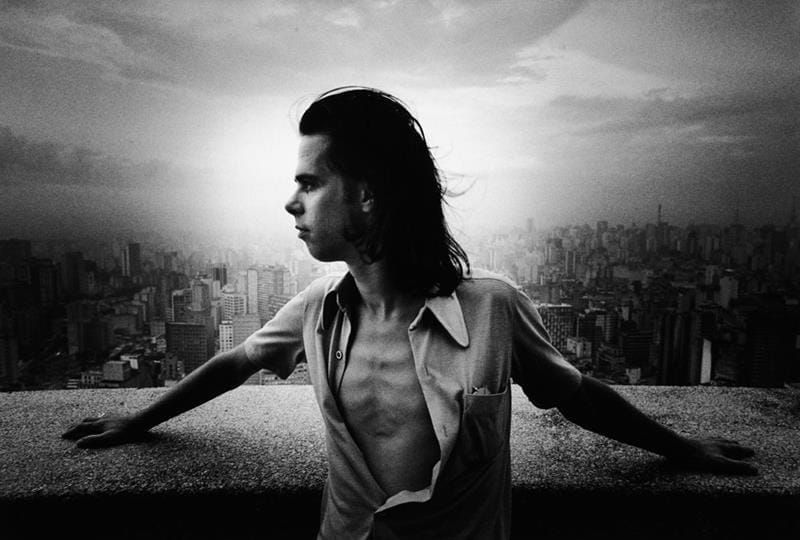
It’s April 1989, the second week of Easter, and Nick Cave can’t see Jesus.
As the Air France flight circles over Rio, clouds obscure the summit of Corcovado, so try as he might to crane his neck, there’s no way to make out the iconic 2,000-foot Christ the Redeemer that watches over the city. All the same, Nick fancies he can feel something of His presence.
Maybe it’s being back in the southern hemisphere, some Coriolis effect of the soul, but touching down in Brazil, he feels his own personal doom spiral slowing.
Last summer, after his arrest and final warning for possession of heroin, he spent two months in rehab in Somerset. Since he re-emerged in September on his 31st birthday, he and the Bad Seeds have completed a white-knuckle, 40-date tour of Europe and North America. He’s survived even an afternoon in a New Cross boozer with Mark E. Smith and Shane MacGowan at the behest of the NME. After the chaos and squalor of 1985–87, it feels like some kind of achievement. Tender Prey, released in September, has got some of the best reviews of his career. And the single, “The Mercy Seat”, feels like an artistic breakthrough – the slow-gathering storm of the Bad Seeds finally breaking in a tumult of electricity and damnation.
But maybe the sweetest relief is the fact that he’s just signed off the final changes to the proofs of his novel, And the Ass Saw the Angel.
He has been lugging the dog-eared, blood-smeared, pestiferous manuscript from Hollywood to London to Berlin ever since it became clear that it was too sprawling and deranged to ever work as a film script. He has been typing at it, scrawling over it, burning it and rewriting the damned thing through sleepless nights across three continents – in dank, damp lofts, squats and tour buses – for the past five years. Maybe even longer. Of all the baggage he brought with him on his first flight out of Melbourne in 1980, the heaviest and darkest was the unfinished business with his dead father.
Colin Cave had impressed upon the young Nick the holy glory of the written word, as manifested by Shakespeare, Dostoevsky, and Nabokov. But even the 13-year-old could see that his dad’s own contributions to the canon didn’t extend beyond some short stories published in the 1960s and a couple of aborted novels, neatly filed but never finished. This stalled ambition was maybe Colin’s biggest legacy to his son. With his own novel now heading to press, has he finally got that wild, howling monkey off his back?
As he walks the streets of Rio, he certainly feels lighter. He’s been fascinated with the country ever since he watched Pixote, Héctor Babenco’s unflinching film about Brazilian street urchins, and even dedicated Tender Prey to the young lead, Fernando Ramos da Silva. But he hadn’t been prepared for the light and life of the city – nor the beauty of the women.
During his months in rehab, his counsellors had advised him to sever all relations with Anita Lane – the woman who has been his muse, co-conspirator, and soulmate for over a decade – on the rationale that he might “project his addiction” onto their relationship. As if anything about Nick and Anita could be easily disentangled.
The two had been inseparable – if not always together or entirely faithful – since the moment they met in Melbourne, 1977. They were like twin hemispheres of the same brain. It was Anita who co-devised “From Her to Eternity”, the very first Bad Seeds song, from their bed in Brixton in 1984. It was her picture at the centre of the credits on the back cover. There was surely something of their mutual erotic vagrancy in the slow, spacious croon that Nick had taken up as leader of the Bad Seeds. She was like a Marianne Faithfull who had actually joined and directed the Rolling Stones. It sometimes felt like every Bad Seeds song should begin with the line “I want to tell you about a girl” – and that girl was Anita.
But now he can feel the spell passing – the end of love, misery and woe. Maybe, he wonders, this bittersweet feeling is the mysterious saudade he’s been reading so much about?
He’s certainly a long way from the Black Crow King. For the past four years, his hair has been not so much a crow’s nest as the entire damned rookery. For the brief duration of the Immaculate Consumptives in 1983, it looked like he was carrying around his own personal mushroom cloud. But he cropped it all off in October 1987 to play Maynard – the psychotic nihilist, with HATE tattooed onto the knuckles of both hands – in John Hillcoat’s brutalist prison drama, Ghosts of the Civil Dead.
Maynard – many of whose lines Nick wrote himself, based on his own brief detention in New York – feels like a reductio ad absurdum of the early Nick Cave persona. He sits in his solitary cell – not too dissimilar to the tiny Berlin priest-hole where he composed And the Ass…, decorated as it is with savage depictions of female genitalia painted in his own blood – calling on the guards: “Come ‘ere… SO I CAN SPIT IN YOUR FUCKIN’ EYE!”
Like his novel, the role of Maynard feels like an epic purging and containment of all the bile, rage and poison that has driven him over the last decade. Is it all out of his system? Is he out of purgatory? His hair has grown back now, but it’s neatly pomaded and combed into a black mane. He’s wearing a smart suit and tie, as though he’s posing for the author photo his father might have appreciated.
As he and the Bad Seeds make their way to the hotel, the mist over Rio seems to burn away and he can feel the sunlight on his face. He can see Christ the Redeemer now looming over the city. It’s almost as though he can feel His blessing.