Rise
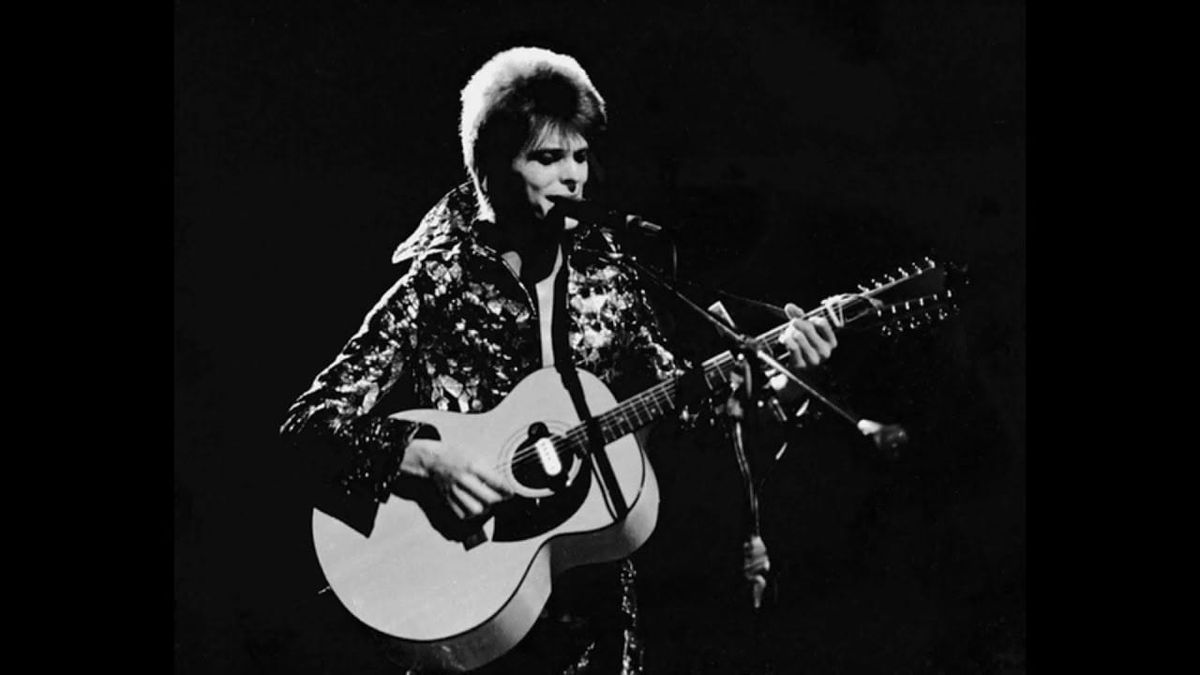
17 September 1972 and Ziggy Stardust arrives in the new world. He’s spent a stately transatlantic week with Angie on the QE2, and when they emerge through customs he has plenty to declare. He’s left behind a land of Ford Cortinas, Bloody Sunday and Slade, and arrived in the world of Nixon, Watergate and Wattstax.
He’d conquered London with insouciant ease: two nights at the Rainbow, Finsbury Park in August, complete with surrealist films, theatrical sets, costume changes and mime, had amounted to a coronation, but now the stakes were raised. Marc Bolan’s dismal US tour at the start of the year seemed to presage his decline and Tony Defries was determined not to make the same mistakes. Rebranded as MainMan, had already set up an office on the Upper East Side, with an entourage including Lee Black Childers, Tony Zannetta and Cherry Vanilla pulled from the Warhol zoo, instructed to “look and act like a million dollars” (and eventually racking up a tour expense bill of about $400,000).
Expenses are only half of it. With a 30-date coast-coast tour scheduled through the fall, David doesn’t have a keyboard player, after Defries’ firing of Nicky Graham. Having been seduced by the cybernetically stoned soul picnic of Annette Peacock’s awesome I’m the One, he invites her to join the Spiders. She demures (though not before taking a $300 a week stipend from MainMan), but suggests her pianist, avant-jazz prodigy Mike Garson, who has little trouble securing an $800-a-week fee. Unbeknownst to him, Weird and Gilly are still scuffling by on a miserly £80 a week…
Making his debut in Cleveland, delicate conservatoire ears stuffed with cotton wool to muffle the PA, Garson brings a bebop wit to the the Hunky Dory ballads - which are now filigreed like the webs of spiders dosed on LSD. But Ziggy is warped even more profoundly by America itself: the psychedelic cocktail of his cresting celebrity and the hysterical paranoia of the culture. Back in 1971 the country’s thrilling psychic stimulants had impregnated David with the very concept of Ziggy: now they are working a darker magic.
“The Jean Genie” is the first delirious product. Worked up from a tour bus riff through the Yardbirds’ “I’m a Man” designed to impress his latest muse, Warhol-Monroe Cyrinda Foxe, it mutates into the theme-tune for some outlaw spirit: Iggy Pop via William Burroughs and Jean Genet. If at heart Ziggy is an attempt to refresh the cosmic shock of rock and roll, recapture that primal rapture of hearing Little Richard emerge from the ionosphere’s shortwave static, by pimping the form with science fiction nihilism and comic-book bravado, then “Jean Genie” is the purest hit yet. Recorded in October, released in November, rising to a dizzying number 2 in the UK charts January 1973, it demonstrates that Ziggy’s infernal momentum is only accelerating…
Driving like a demon, from station to station, Ziggy careers through the air-conditioned nightmare. Carnegie Hall is a sell-out, with Truman Capote, Andy Warhol, Tony Perkins and the New York Dolls in attendance, but in St Louis scarcely 200 devout midwest glitterkids shiver within the 11,000 capacity Kiel Auditorium.
Nevertheless his spaceface antennae are alert and twitching. Riding the Super Chief train through the long midwest nights from Kansas to Los Angeles, from Seattle to Phoenix, he is high in the observation lounge, gazing out across the plains. Catching sight of strangely luminous lunar domes in the landscape, he’s dreaming of post-apocalyptic prairies, where townsfolk have become glozing neuters, looking to tapes of rock and roll and old Hollywood to rekindle their vital spark. “Drive-In Saturday” is another sublimely inspired Ziggy single, like Roxy Music going doo-wop or David Lynch directing American Graffiti.
But like thawing midwest ice, something is slowly crazing in the Ziggy cortex. Maybe it’s the fact that only 200 hundred determined Arizonans turn out to see him debut the song in Phoenix on 4 November. Maybe, as he later claimed, it’s a premonition that Mott would turn the tune down when he munificently offered it to them. Maybe it’s just the new chemicals and fame coursing through his veins. Or maybe it’s a self-harming first stab at hacking off a mask that’s become too attached… He emerges from his hangover the next morning to find that in his intoxicated fugue he has shaved off one of his eyebrows, rendering his already uncanny eyes even spookier, his very pale face profoundly skewed…
If it is a self-harming, subconscious attempt to remove a mask, then the mask attaches itself ever more firmly. The cover of Aladdin Sane, shot by Brian Duffy on David’s return to London to complete the album in January 1973, with a savage slash of technicolour lightning across his downturned eyes, is the most sublime Ziggy icon yet. It’s also the most expensive album cover made, printed in seven colours in Switzerland.
It’s another sign of MainMan’s demented chutzpah, and an attempt to ensure that RCA commits to promoting the album fully. The project is gathering a pace no one can slow, but is still haemorrhaging money, with an entourage of almost 50 joining the band for the second leg of the US tour.
The debut show at New York’s Radio City on Valentine’s Day 1973 is another sensational sellout, with Salvador Dali and Bette Midler in the audience to witness Ziggy descend to the stage within the Rockettes’ silver gyroscope. But during the encore of “Rock and Roll Suicide” a fan rushes onstage to the call of “give me your hands!” and the singer collapses. Some in the hall swear they hear gunshots, and surely this is where the whole ludicrous, self-fulfilling prophecy is heading? The kids kill the man, Orpheus is torn to shreds by the frenzied Maenads…
The faint is diagnosed as exhaustion - brought on by the relentless pace, and, says an attending nurse, “stage make-up blocking the singer’s pores”. The mask is rapidly devouring the man. How much longer can Ziggy Stardust last?