Conception
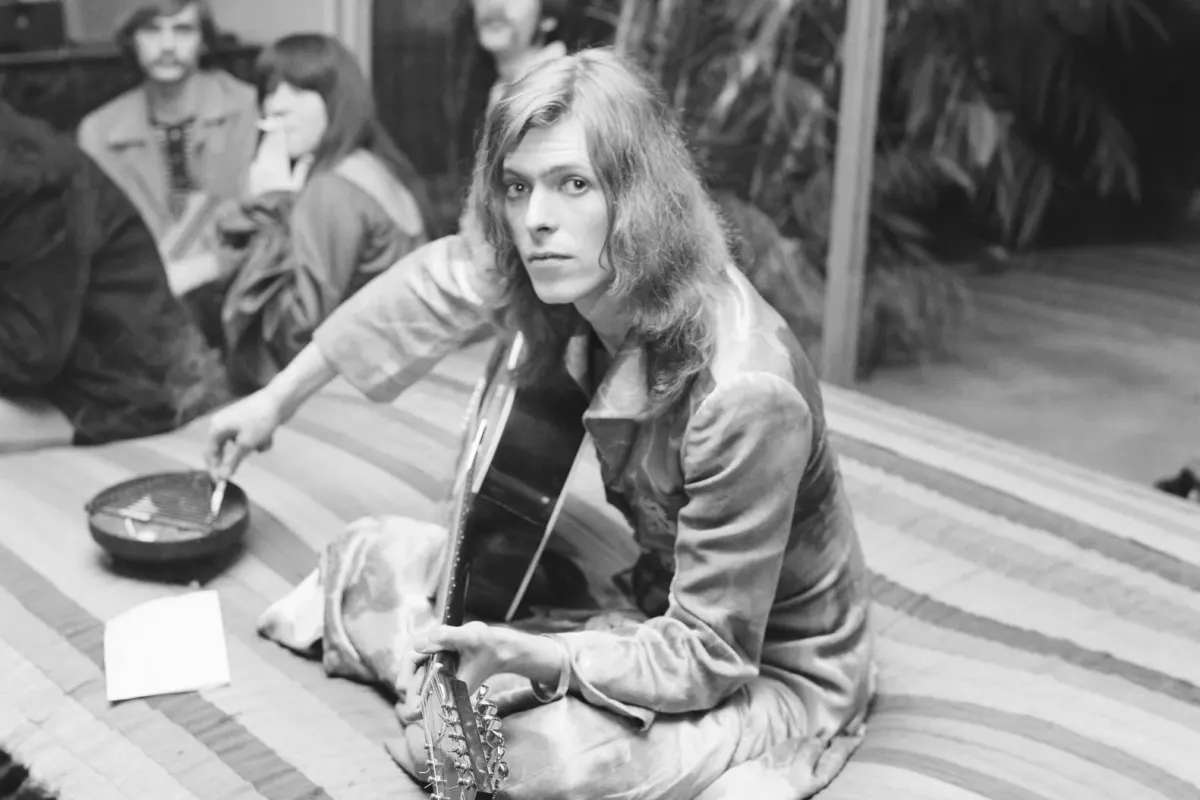
13 February 1971, five miles above Monterey, and David Bowie’s heart and mind are racing. It’s not his fear of flying, which won’t really kick in for another couple of years yet, after a stormy flight back from Cyprus. And it’s not the imminent approach of Los Angeles, which is still an alluring prospect rather than his own personal abyss. It’s definitely not the side-effects of the cocaine, as his budget barely stretches to cheap coffee at San Francisco airport. It’s just that, as he looks down on the electric-blue Pacific lapping against the south Californian coast, he feels, for the first time in years, like has found some fucking perspective.
He’s been adrift for months now. “Space Oddity”, which rose into the top five in the moonage autumn of 1969 seemed to be the big break he’d desperately plotted for so long, but fizzled out into one more failure to launch. The follow-up “The Prettiest Star”, written in his first swooning infatuation with new wife Angie, and featuring faltering lead guitar from Marc Bolan, sold barely 800 copies in March 1970, and already seemed marked with melancholy for fleeting fame.
He had picked up Disc magazine’s award for “Brightest Hope” at the Café Royale from Cliff, but his prospects seemed dim. He was back at square one, scuffling around for a fresh direction: teaming up with Lindsay Kemp once more in another production of Pierrot in Turquoise (now renamed The Looking Glass Murders for Scottish TV); holding court in the back of the Three Tuns to a gaggle of earnest teens at the Beckenham Arts Lab; re-releasing the cracked showtunes of his Deram days as The World of David Bowie for Decca; still hawking songs from the Space Oddity album on John Peel’s Sunday Afternoon Show… Somehow destiny as a one-hit wonder seemed even worse than abject failure. He’d been so close he could taste it: the acclaim, the rapture, the power... He couldn’t stop now.
Booked to support Caravan and the Groundhogs at the Roundhouse one Sunday at the end of February he was still casting around for a name for his band, now including Tony Visconti on bass, John Cambridge on drums and one of John’s mates from Hull, a young guitarist called Mick Ronson… The Tony Visconti Trio? David Bowie’s Imagination? Harry the Butcher??? Manager Ken Pitt ultimately suggested the Hype, and with Angie’s help, Bowie had drafted a sketchy concept…. a star-spangled band of Jack Kirby superheroes? Singing about Nietzschean supermen? It seemed like a pretty desperate last roll of the dice.
Nevertheless, on 22 February they took to the stage as Cowboyman (Cambridge in 10-gallon hat), Hypeman (Visconti in Dr Strange cape), Gangsterman (Ronson in zootsuit and thick polka dot tie) and Bowie himself, growing out his shaggy footballer’s perm, in knee-high boots and a skyblue cape, like Pierrot from the planet Mongo, as Rainbowman.
Even Marc Bolan in the audience couldn’t keep a straight face. But despite widespread derision, Bowie felt some tingle or throb of the future. Maybe it was the swish of satin and tat. Or maybe it was the determined swagger of Mick Ronson, who had left a job laying school football pitches in Hull to come and lodge with the Bowies at Haddon Hall, their gothic pile in Beckenham, and had the alchemical guile to transform the tentative 12-string doggerel of “Width of a Circle” into an infernal metal epic, like Cream performing at Ragnarok.
Something demonic certainly seemed to possess Bowie: two months later, recording the track in the sessions for The Man Who Sold the World in Fitzrovia and emboldened with Faustian daring, he dismissed Ken Pitt, and signed up with showbiz lawyer and monstrous Mickie Most protege, Tony Defries.
But even Defries couldn’t seem to give Bowie the kickstart he hoped for. The Man Who Sold the World was completed by the end of May but wouldn’t be released by Philips, confused at how to market an album of lurid, psychodramatic hard rock, sleeved in a photo of the singer reclining on a chaise longue like Greta Garbo styled by Dante Gabriel Rosetti, until November. On its release, according to its creator, “it sold like hot cakes in Beckenham - and nowhere else”.
Oddly enough though, it found an audience in San Francisco, where Rolling Stone’s John Mendelsohn praised it as almost “uniformly excellent… intriguing as it is chilling”. Three months later, following a whistle-stop press tour for Mercury across the states, including a night in New York where he witnessed the Velvet Underground at the Electric Circus, and enthused, enraptured, to Doug Yule for 15 minutes, in the belief that he was talking to Lou Reed, he meets Mendelsohn who drives him to San Jose for a radio interview, where he suggests Bowie plays a track from the debut album by The Stooges…
“I think I’ve been in prison for the last 24 years,” he says later. “Coming to America has opened a door...” Far from Bromley, far from Soho, far from the mockery at the Roundhouse, somewhere over the rainbow between the fake Velvets, the out-of-this-world Stardust Cowboy and the luridly real Stooges, David Bowie has found something on the road. Something in his brain has been unlocked by the sights and sounds of America, and he’s emerged into the Oz of his imagination.
And now, as begins the descent over Santa Monica into LAX, he feels it all welling up inside him. Some rough beast is about to be born - not immaculately, like some god fresh from the brow of Zeus, but messily, spectacularly, like the creature emerging out of John Hurt in Alien. And as the plane touches down in Los Angeles, David Bowie does not slouch toward Bethlehem: he struts, like some cat from Japan...