Birth

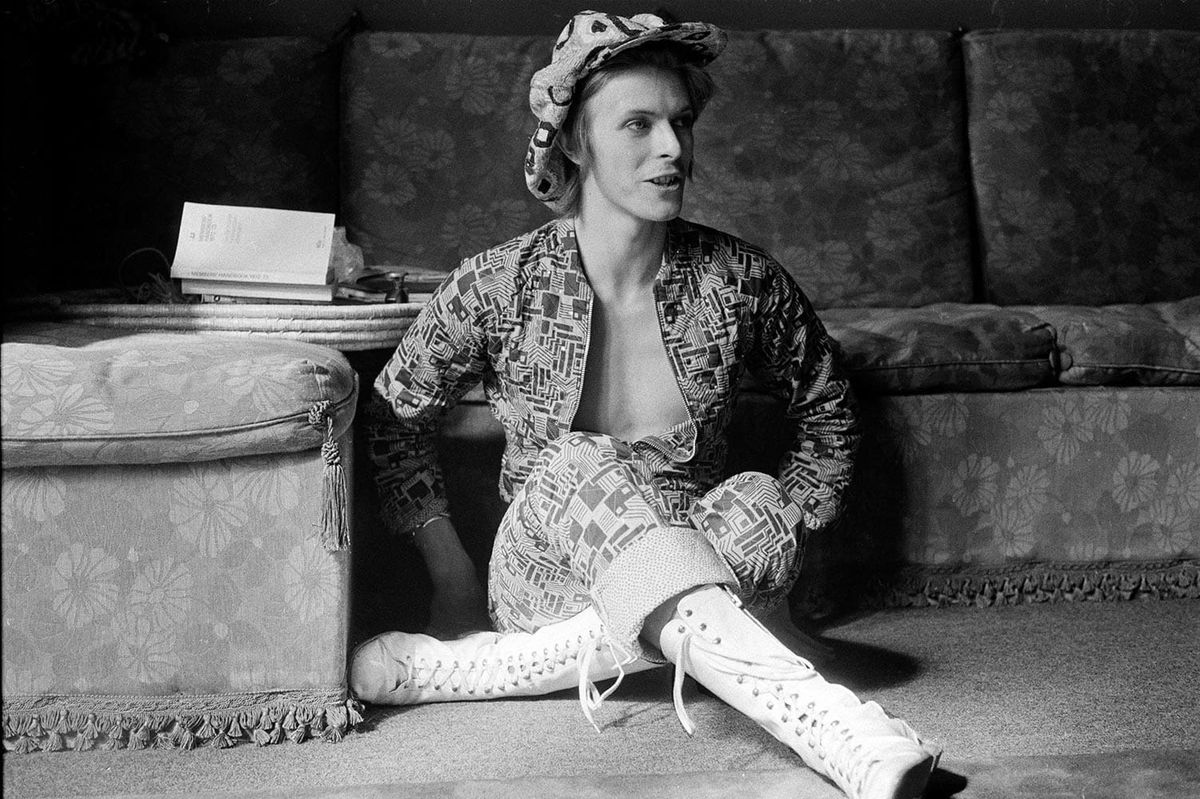
Saturday 8 January 1972, a bleak midwinter evening on the outskirts of south London. Derby County have beaten Southampton, on their way to an implausible first league title with Brian Clough. Dr Who has just encountered assassins from the 22nd century in the second episode of Day of the Daleks. And a motley crew of unlikely aliens have touched down in Beckenham to celebrate David Bowie’s 25th birthday.
There’s Tony Defries, his manager, who has successfully extracted David from Mercury, and won him a new contract with RCA, who just the previous day have released “Changes”, the first single from Hunky Dory. Tonight Tony has brought along Lionel Bart, one-time king of the pop musical, now very much on a downward spiral, as though he senses this will be a memorable opening night. There’s his new RCA labelmate, Lou Reed, who has made the long journey down from Willesden and the dismal sessions for his solo debut, with New York scenesters Richard and Lisa Robinson. There, though they don’t know it yet, are the Spiders - Mick Ronson, Trevor Bolder and Woody Woodmansey, still looking more like municipal park-keepers from Hull than intergalactic rock visigoths. And there, swishing in satin, is Freddie Burretti, who David had briefly rechristened Rudi Valentino, lead singer with Arnold Corns, his fizzled summer 1971 dalliance with manufacturing a boyband to perform just some of the songs that began pouring out of him on his return from LA last spring.
Freddie was no frontman but is a visionary tailor. It was he who found a lime-green mock Liberty print and fashioned it into David’s birthday outfit for tonight - a kind of art-deco spacesuit, accessorised with padded crotch and knee-high red vinyl boxers boots - an advance homage to Kubrick’s Clockwork Orange, about to premiere in London. The outfit is topped with a radical new ‘do, courtesy of Sue Fussey, a nice girl from Bromley who cuts David’s mum’s hair. Bowie had shorn his pre-Raphaelite locks the previous autumn, and let Trevor hack them into a kind of elfin mullet that was still a little too Rod Stewart. Inspired by a Vogue cover shoot by Alex Chatelain, Sue completes the regeneration from Hunky Dory’s colourised Garbo to the ambisexual extra-terrestrial of 1972.
And of course David has engineered his party entrance to perfection. Descending the purely ornamental Hadddon Hall staircase to greet his guests, he is as ravishing as Rita Hayworth in Gilda, as eerie as Klaatu emerging from the saucer in The Day the Earth Stood Still, as unsettling as Alex swaggering into the Korova Milk Bar, and maybe, as “Changes” becomes his fourth flop single in a row, as desperate as Norma Desmond descending her own staircase in Sunset Boulevard. Whatever: Ziggy Stardust is finally ready for his close up.
The next week, on the same day Clockwork Orange opens in London, with the band still not convinced of their new clobber, David heads outs alone onto Heddon Street beneath glowering London skies with photographer Brian Ward and poses inside a red telephone box, as though he is Superman, about to emerge into his new identity, or a timelord about to warp all notions of time and space.
Like a safecracker who has diligently dialled the tumblers for years, suddenly the numbers and the planets have aligned. The following days, weeks and months play out with uncanny ease, as though the cosmos has finally granted him a boulevard of green lights: the teaser Radio 1 sessions for John Peel and Bob Harris, the teasing interview with Melody Maker, the first gigs at Aylesbury Friars Club and the Toby Jug in Tolworth, and an immaculate performance on the Old Grey Whistle Test.
Like HG Wells’ Martians arriving in Woking, or Quatermass’s alien landfall at Wimbledon, the Spiders plot their own invasion of the dozing English suburbs through the spring of 1972: High Wycombe, Chichester, Eltham, Hemel Hempstead, Dunstable, Worthing… all the poses, the sly bits of stagecraft, the set dynamics are meticulously assembled.
The final piece of the puzzle falls beautifully into place with the release of “Starman” on 28 April. Only composed at the insistence of RCA, who failed to hear a single from the album sessions, it’s a spacedust amuse bouche before the album proper, Ziggy’s A Star Is Born moment, borrowing a shameless Broadway octave leap from Judy Garland’s “Somewhere Over the Rainbow”.
It is also David’s cold-blooded revenge on Marc Bolan. For over a year now he’s patiently bided his time as his old comrade has kicked open the 1970s and lit up the grey post-Beatles skies with a stellar constellation of singles. “Queen Bitch”, David’s Velvets pastiche from Hunky Dory, is just one confession of the frustration it stirred in him. Now just as Marc releases “Metal Guru”, his final number one, David is ready to eclipse him. “Starman” shamelessly steals the satyr singalong coda from “Hot Love” and stealthily rises up the charts. By the start of July, a couple of weeks after the release of The Rise and Fall of Ziggy Stardust and the Spiders from Mars, it hovers just outside the top 40, enough to secure an appearance on Top of the Pops, alongside Tony Blackburn, Gary Glitter, the Sweet and Donny Osmond…
By July he is back on Top of the Pops and is the true magic of the pop moment: a shimmering electric-blue 12-string and a psychedelic snakeskin catsuit; a Bolanesque flick of the head and casual arm around the shoulder of golden god Mick Ronson; Martian morse code guitar and a witchy finger pointing straight down the lens of camera 1… all seducing and systematically deranging the senses of an entire British pop generation.
“Starman” stalls at number 10, but the spell is complete: 10 years after forming his first band, David Bowie is an overnight sensation. The following weekend he returns to Aylesbury, but this time trailed by the world’s press, only too eager to proclaim him “The Elvis of the 1970s”. The next day he holds court at the Dorchester Hotel, like Alexander entering Babylon, arm in arm with Lou and Iggy, once his inspiration, now his proteges. Before the end of the month, this leper messiah will raise the dead, casually gifting Mott the Hoople their first hit single with the imperious “All the Young Dudes”. What fresh worlds were left to conquer?