New York was home, and now it's not
2012: Rockefeller Cinderella
Lizzy Grant was born in Manhattan in the summer of 1985, the daughter of an honest-to-goodness Mad Man, who decided that New York City was no place to raise a child and so hightailed it with his wife to Lake Placid, pop. 2,485, where the greatest peril is the chance of a nasty pond hockey injury.
But Lana Del Rey? Well she might have been born on the Hudson-Bergen light rail that took Lizzy took from her trailer park in New Jersey to her Gansevoort St studio every afternoon in November 2007, filling her head with the Manhattan skyline and dreams of the big time.
So to be performing her debut single on Saturday Night Live, less than five years later, is some kind of New York fairytale. She’s the Rockefeller Cinderella. She played a secret warm up gig back in September in her old Williamsburg stomping grounds, and was billed as “the Queen of Coney Island”. But this is surely her coronation as Queen of NYC.
Watch it today and the SNL episode from 14 January 2012 is like a time capsule from the heart of the Obama era - only 12 years ago, but as cosy and complacent in its way as any Norman Rockwell homily. Daniel Radcliffe hosts, shyly promoting his first post-Potter project, and the episode hobbles along with a string of lame satires of try-hard youtubers, Taylor Swift and Target cashiers.
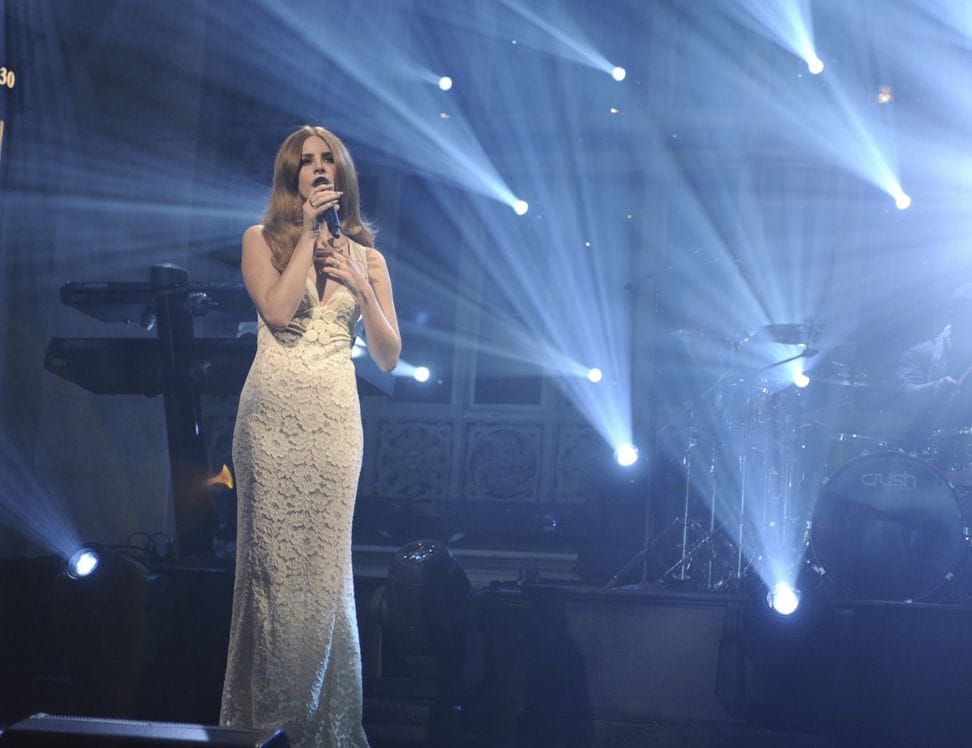
Maybe the reaction to Lana’s two appearances, singing “Video Games” and “Blue Jeans”, was an early sign of what was to come. She looks eerie but immaculate - her hair a strawberry blonde Jane Fonda dream of 1968, her dress a Moschino whim of chantilly lace. But there’s a dawning, existential dread to her expression. She looks like a bridesmaid who has drunk too much at the reception and just had an awful premonition of the hangover to come.
She shuffles and twirls across the stage, like someone retracing their steps, looking for the keys that might get her out of this place. She sings, and in her mind she’s Callas as Medea, La Scala 1953. But everything comes out too high or too low, like she can’t make up her mind to be Eartha Kitt or Betty Boop.
How on earth had she got here?
When she uploaded her homemade clip for “Video Games” to YouTube in May 2011, Lana became the first authentic pop star of the 21st century. That is, if you define pop authenticity not as a prosaic matter of biography and background, but in its proper, grandest sense, as the ability to dream up, inhabit and convey a world that’s all your own devising.
In its own way it’s as pivotal a moment as Elvis or the Beatles on Ed Sullivan, Ziggy on Top of the Pops, the Pistols on Bill Grundy or “Smells Like Teen Spirit” on MTV. New, inchoate audiences were forming and fusing out of the neural, cybernetic suture of iPhone, Twitter, YouTube and Spotify. The cultural ionosphere was charged and seething with new electricity. And Lana Del Rey, this skinny, pouty kid with an iPhone and an encyclopaedic collection of vintage YouTube clips, was the lightning rod for the burgeoning atmospheric, algorithmic disturbance.
Of course, it helped that she had written one of the greatest pop songs of the century. After a chance meeting at the CMJ conference in October 2009, she’d been freed from her contract with the witless Five Points Records and spirited away to London where her new managers tried to groom her for relaunch. More experienced advisors might have fostered the talent that had conjured an imaginative world and already populated it with over one hundred songs. You could imagine putting her in a studio with a Warren Ellis, Bernard Butler or Adrian Utley to refine her cinematic vision.
Instead, strapped for cash, with little label interest, they engineered sessions with a dizzying, disparate array of jobbing pop writers - Guy Chambers (Robbie Williams), Liam Howe (Sneaker Pimps), Chris Braide (Cheryl Cole), Tim Larcombe (Girls Aloud), and Rick Nowels (Belinda Carlisle, Madonna). Even among this motley crew the presence of Justin Parker, one-time guitarist in early-90s baggy stragglers Passion Fruit and Holy Bread seemed an anomaly.
He was on the dole in Lincoln, barely able to afford his train fare into London. But one Saturday afternoon in July 2010 he somehow unlocked the essence of Lana that Lizzy had been circling around for a couple of years. It was like a safecracker hearing the tumblers fall into place and breaking the bank of Monte Carlo.
Four spare piano chords, a tolling church bell, some sampled strings and a sprig of harp. It was like the final scene of Vertigo distilled into four minutes. Suddenly a limited lyrical world that already risked self parody - fast cars/old stars/bad girls/dive bars - seemed rich and pregnant with possibility. With the final addition of a signature collage video - a woozy cocktail of super-8 home movies and Hollywood squalor, stirred together with the kind of artful selfies a wistful teenager with a new phone and a vintage clothes habit might make - and the spell was cast.
If Lana was the lightning rod, then with the Saturday Night Live performances she bore the full force of the gathering storm. The instant, infernal reaction carried on to the release of Born to Die the following month. As an album it was as messy as its cast of writers, but for the four uncanny minutes of “Video Games” everything came into spectacular focus. There was a whole world for her. But to fully explore it meant getting the hell out of New York. She booked a one-way ticket to LAX and reserved a suite at the Chateau Marmont.