Beatles 6: George
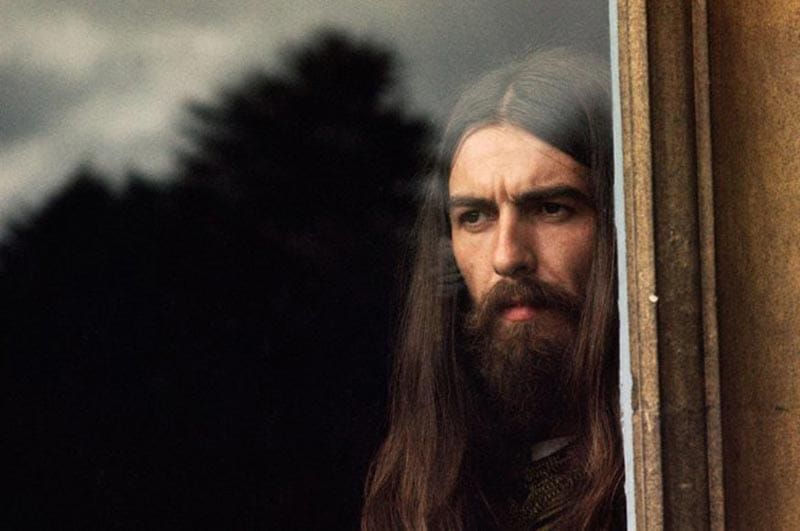
George Harrison is just getting warmed up.
“People always say I'm the Beatle who changed the most,” he tells the man from the BBC’s religious affairs show, Fact or Fantasy? as he’s interviewed in his office in the Apple building, now an empty shell of its former psychedelic glory. “But, really, that's what I see life is about. The whole thing is to change and try to make everything better and better.”
It’s April 10 1970 and the front page of the Daily Mirror plainly states that Paul has quit the Beatles. It’s the final confirmation of what has been an open secret for months now: the band are over, falling apart in a bitter, very public mess of litigation, recrimination and solo projects. And George for one seems almost demob happy, finally enjoying the attention, the interview requests that have increased exponentially after “Something” and “Here Comes the Sun” on Abbey Road seemed to announce his official arrival as a Beatles songwriter.
Talking with the enthusiasm of a man recently released from a vow of silence, George sees no beginning and no ends, only transformation. “The ocean is always changing,” he says gnomically, “but the bottom of the ocean is always calm and still”.
Maybe he is taking the final dissolution of the band he’s been part of for over a decade so well because he’s left the band so many times before. Way back in November 1960 he had been the first Beatle to leave Hamburg, just as it looked like they were moving up on the showbiz ladder, deported once Bruno Koschmider finally lost patience with the scouse hooligans and informed the police that he was still only 17.
In 1966, on the plane back from the USA, after the final concert at Candlestick Park, the culmination of the catastrophic world tour, he had sighed with some relief, “Well that’s it. I’m not a Beatle anymore”, before heading off to explore India with Ravi Shankar.
And last year, in January 1969, barely a week into the filming of the Let It Be sessions, he decided he’d had just about enough of Paul lecturing him on how to play lead guitar, and calmly informed the boys that he would see them “around the clubs”, before driving back to Esher.
This last exit seemed to mark a real acknowledgement of growing importance in the band. When the boys tried to talk him around (having briefly considered Eric Clapton as a possible replacement) he was able to insist on his own terms: that they leave the vast freezing Twickenham studios for the basement studio in the Apple building, and finally give up all these hare-brained schemes for playing one last show on an ocean liner, a volcano or a Roman amphitheatre.
His idea of inviting Billy Preston, the sensational young organist they had met in Little Richard’s band back in Hamburg, to the sessions had been a particularly inspired suggestion. He was still thinking of the Band, the Thanksgiving dinner he had spent out in Woodstock in 1968 where he had got an inkling of some other band dynamics, harmonies built on communal spirit rather than domination and showbiz rivalry. Paul had cultivated the Garth Hudson beard, but seemed determined to be the band leader rather than team player.
The song that pushed George over the edge at Twickenham had been “Two of Us”, which Paul played incessantly, desperately trying to engage John. Ever since they all first came together, on the top deck of some bus in Liverpool back in the 50s, George has felt like the spare wheel, the eternal kid brother, the tag along. Ten years later it seems to him they are all still stuck in the same schoolboy ruts. Doesn’t anyone want to evolve?
George has had glimpses of where he wants to go with the songs that seem to be pouring out of him. In India, playing with Ravi Shankar, and traveling through Jaipur and Varanasi, watching thousands bathe in the Ganges, seeking rebirth. Tomcatting around with Clapton and watching Jimi Hendrix light up London, spinning starlight from the strings of a Fender Stratocaster. And hanging out with Dylan and the Band in Woodstock, grooving on some low key intimate magic.
By now he reckons enough material for a triple album at least just from songs that John and Paul have passed over in favour of the likes of “Revolution 9” and “Maxwell’s Silver Hammer”. Phil Spector for one seems mightily impressed,and the EMI studios at Abbey Road are already booked for 20 May, the same day as the film of Let It Be is finally due to premiere.
But George tells the BBC crew nothing of these plans. When they pack up their equipment and leave, he creeps around the Apple Building for the first time as an ex-Beatle. Paul and Linda have decamped to Scotland to escape the media storm. John and Yoko are doing primal scream therapy out at Tittenhurst. Ringo is shamelessly peddling his debut album. The Apple scruffs outside speak to the world’s media in disbelief. The corridors of the Apple Building, gutted by Allen Klein’s new regime, are no longer lined with Hells Angels, beat poets and Magic Alex. But he does find Derek Taylor, the Beatles’ indefatigable press officer, a last hold out, still sanguine.
Like some psychedelically defiant Minister of Information, maintaining the old esprit de corps, even as enemy tanks approach, he’s tapping out one final press release to issue to an incredulous media. “Spring is here and Leeds play Chelsea tomorrow and Ringo and John and George and Paul are alive and well and full of hope,” he writes with customary brio. “The world is still spinning and so are we and so are you. When the spinning stops – that’ll be the time to worry. Not before. Until then, The Beatles are alive and well and the Beat goes on, the Beat goes on.”