Beatles 2: George Martin
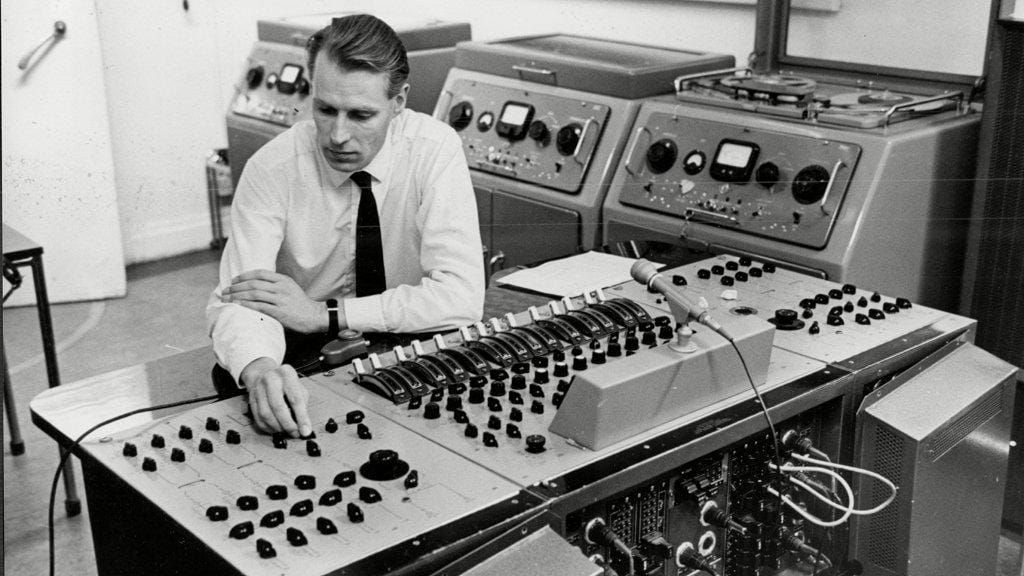
1962 has been quite a year for George Henry Martin.
As head of Parlophone, he’s had top ten hits with both Matt Monro and Bernard Cribbins. Under the name Ray Cathode, recording with Maddalena Fagandini from the Radiophonic Workshop, he’s launched “Time Beat”, an early probe into the strange new cosmos of electronic pop. With Rolf Harris he’s concocted a barmy, brilliant smash hit in “Sun Arise”. And thanks to the burgeoning popularity of his 1961 live recording of Beyond the Fringe, he is, after all this time as EMI’s resident curator of novelty, comedy and light classical records, almost fashionable.
But he has never felt quite so excited as he does this evening, 26 November in the EMI studios on Abbey Road. He had, it’s true, hardly been thrilled when he had been presented with The Beatles that summer, informed they were his new signings, and, what’s more, that their first release was to be a song they had written themselves. But he’s worked long enough within this company to tolerate the old school ties, the nods, winks and back stage deals, the strange obligations.
When they strolled up to Abbey Road in June they had seemed plainly incompetent. The drummer couldn’t keep time, their songs seemed to be half-baked, insipid echoes of skiffle, and he couldn’t work out which of the boys, John or Paul, to make the lead singer. He had a surefire hit song, “How Do You Do It?”, that they stroppily refused to even countenance. He was obliged to record six songs with them, and that would be that.
What’s changed? They’ve got rid of the drummer for a start, brought in a new boy, Ringo, who in all honesty does not seem a great improvement. They have, despite his very low expectations, scored a surprise hit single with “Love Me Do” - and surely even their manager can’t have bought enough copies to have pushed them into the top 30? And they’ve brought in a new song, “Please Please Me”, written by John, straight after the dismal recording session in June, that is just out of this world.
But beyond all this, he feels thrilled to be in the same room as them. In their own adenoidal way these Liverpool grammar school boys are as scathing as Peter Cook, as surreal as Spike Milligan as sonically curious as any of those Radiophonic boffins. That they refer to EMI’s golden boy, the hated Norrie Paramour, as Noddy Paranoid only helps matters.
“Gentlemen,” he announces on the studio intercom in his best BBC tones at the end of the “Please Please Me” session, like he’s about to introduce the Shipping Forecast or the National Anthem, “you have just made your first number one record.”
He feels this thrill and he’s already plotting their debut album (a show recorded live at the Cavern?), but even George can’t conceive what 1963 holds in store. No one can. Brian Epstein has carefully plotted out the calendar for the year ahead as though this was a conventional showbiz escapade, something on the level of Tommy Steele or Cliff. There’s a visit to Stowe School (at the invitation of precocious pupil John Moores, heir to the Littlewoods fortune, a useful contact to cultivate). There an end-of-the-pier summer season through the Adelphis, Rialtos and Gaumonts of Margate, Blackpool and Great Yarmouth. And to cap it all off, there’s panto season at Finsbury Park Astoria with the Barron Knights, Rolf and Cilla.
But things aren’t going to plan. They’re already much bigger, richer, stranger and wilder than that. Over the next 12 months George and the boys record an album (Please Please Me, recorded in 12 hours on 11 February 1963), plus three further singles that seem to blow open first pop music, then Britain and then the twentieth century itself with every release. In their own way, the experiments that George and the boys conduct in Abbey Road Studio Two are the cultural equivalent of the Manhattan Project.
In February 1963, however, heading out on a tour bus with Helen Shapiro, Kenny Lynch and Dave Allen, on an Arthur Howes package tour of Yorkshire and the west Midlands, the boys are still earning £80 per week. Things are moving too fast for British light entertainment to quite keep up, there’s an uncanny lag, like the gap between the crash and the roar of the V2 rocket. Very soon they’re headlining, Roy Orbison is their support act and Little Richard is trying to claim he invented them
George seizes the opportunity to build his own little empire. Visiting Liverpool, scouting suitable locations to record the debut album, he meets and signs Gerry and the Pacemakers, who are only too happy to perform “How Do You Do It?”. In fact, as Brian is keen to share, it turns out there’s a seam of talent rich as the jam butty mines of Knotty Ash, with Billy J Kramer and Cilla Black following, eager to help satisfy this insatiable appetite for John and Paul’s songs. Pretty soon the entire UK top 10 is their own personal playground.
“She Loves You”, written on the tour bus after their 26 June gig at Newcastle’s Majestic Ballroom, recorded on 1 July, the day after they play Great Yarmouth ABC Cinema, and released on 23 August as they’re beginning their residency at Bournemouth Gaumont, sublimely captures the gathering hysteria. There’s a feedback loop at work: the falsetto whoosh of John, Paul and George provoking the screams of the girls in the cheap seats, warping back into the fabric of the music, each driving the other to further extremes.
But in the speed of the ascent, signs of stress, fatigue and fracture are being to show. Not just in the shower of confectionary that pelt them every night after George confesses to a liking for Jelly Babies or the hot stench of girl piss that rises up from the stalls at the end of every show. But also in the rattling tubes of prellies that fuel the endless tour itinerary, and the blackout fury that John falls prey to at Paul’s 21st birthday party, when he batters longtime supporter Bob Wooler. On 16 October it’s announced that the Beatles have been booked to perform at the Royal Command Variety Performance. In the gathering storm of autumn 1963, it’s not clear that either institution will survive the encounter.